
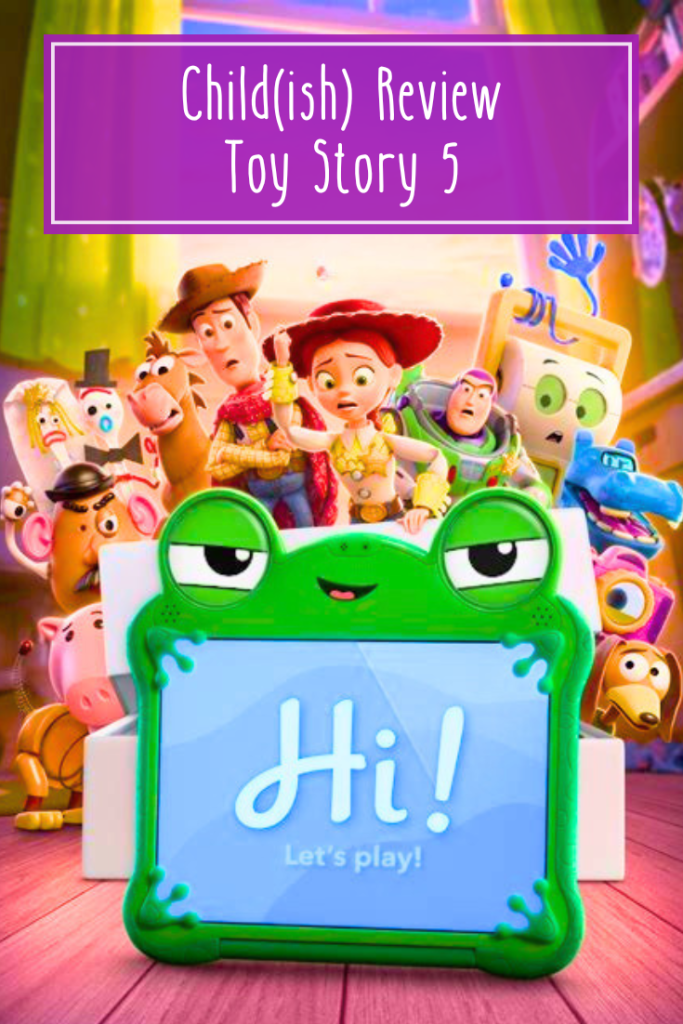
I’ll be honest, I never really got into the Toy Story franchise. I know Woody, Buzz, and Jessie are beloved icons, but I just wasn’t into sitting down and watching the movies when they came out, and even now as a parent. So when Patti told me Toy Story 5 was coming out and I casually mentioned that I was indifferent, the gasp she let out was audible. For reference, the first Toy Story came out when we were 10.
But then the Toy Story 5 trailer dropped, Lilypad appeared on screen, and suddenly I was fully invested. In this installment, Bonnie is introduced to a new high‑tech tablet which completely disrupts the balance of playtime, forcing Jessie, Bullseye, Buzz, Woody and the rest of the gang to confront what it means to matter to a child in a digital age.
Toy Story 5 is essentially a child‑development case study wrapped in a Pixar movie. The film directly tackles themes that map onto core developmental domains: social-emotional growth, imaginative play, peer relationships, technology use, and the psychological experience of being “enough.”
“Why won’t anybody be my friend?”
Bonnie’s line to her parents is heartbreaking because it captures how deeply she wants connection. In Toy Story 4, Bonnie has a very hard time making friends at her first day of school. In this movie, she still struggles with finding the confidence to introduce herself and comes off a bit awkward.
The real issue is not Bonnie’s lack of social skills, but that the kids around her have moved away from imaginative play and onto devices. Her neighbors and the girls in her dance class are absorbed in tablets and barely interact with one another, leaving Bonnie without peers who still know how to connect in the way she does.
Bonnie’s parents give her Lilypad hoping it will help her fit in and finally make friends. It works at first, but only on the surface. Lilypad pulls Bonnie into group chats and digital interactions, yet the connections she gains are shallow, performative, and sometimes mean‑spirited. This hits closer to home for us, since Bonnie is 8 years old in this movie and our kids are learning how to navigate these exact situations.
In the movie, Bonnie wants so badly to fit in that she’s willing to distance herself from her favorite toys after being made fun of. Bonnie goes back and forth, needing the emotional comfort of Jessie but also being embarrassed by it. This mirrors what actually happens developmentally around ages 8–12, when peer acceptance and social hierarchy become central to a child’s identity. While the film doesn’t portray technology as inherently harmful, it shows how digital connection without real emotional grounding can leave kids feeling more isolated than included.
Is tech really the villain?
In the movie, Lilypad proudly explains that “she has all of Bonnie’s developmental needs covered.” Yeah, we jumped on that one pretty fast…
The film highlights how technology can crowd out meaningful play at home, echoing real concerns about children’s growing screen dependence. When screens replace hands‑on, imaginative activities, kids lose opportunities to practice problem‑solving, empathy, and collaboration. In the story, Bonnie’s creativity and pretend play begin to fade as she becomes increasingly absorbed in Lilypad. The device offers online communication and gaming, but not the kind of open‑ended, creative, and socially rich play that supports healthy social development and emotional safety. Behaviorally, you can see that with more time spent with Lilypad, Bonnie stops paying attention, loses track of time, becomes more insecure, and throws more tantrums.
Technology is also shown accelerating how quickly kids grow up. Jessie even notes that Blaze’s bedroom looks more like a teenager’s space than that of a 9 1/2‑year‑old. Bonnie sees the same shift in her dance class, where the girls respond to her toys with, “Oh, you still play with toys?” as if imaginative play is something she should have already outgrown.
Still, while it’s easy to focus on the downsides of digital devices, there are real benefits too. For kids like Bonnie, who may struggle to make the first move socially, tablets can offer an easier entry point into connection. Tech toys (with the help of Jessie) help her meet Blaze, a girl who shares her love of imaginative, creative play, giving Bonnie a bridge into friendships she might not have formed otherwise. Technology isn’t the enemy; disconnection is. When used intentionally, tech can facilitate real relationships rather than replace them.
The truth is that technology has always shaped (and will continue to shape) the toy industry. We’ve gone from phones and televisions to early electronic toys and now to tablets and app‑based play. And whoever designed the ultra‑tech Buzz Lightyear figures deserves credit. They’re a smart blend of open‑ended play and interactive tech, giving kids opportunities to use their imagination on an entirely new level.
A Toy’s Purpose
The arrival of Lilypad forces Bonnie’s toys to confront their own obsolescence, mirroring how children’s interests shift as new forms of play enter their lives. Even Blaze’s old tech toys reflect on the brief but meaningful role they once played before being set aside, underscoring how quickly childhood attachments can change in a tech‑driven world.
While it’s a sad idea from a toy’s perspective, it’s developmentally typical for children to outgrow their toys. In fact, it’s a healthy milestone. It reflects a growing orientation toward peers, the emergence of more abstract thinking, the beginnings of identity formation, and increasing autonomy. Yet the Toy Story films frame this transition with tenderness rather than loss.
Despite Jessie’s memories of feeling abandoned when Emily outgrew her, she eventually learns that Emily never truly forgot her. It reinforces the idea that toys show up for children during the moments that matter most. For Smarty Pants, that meant being part of Blaze’s potty‑training years, and for Jessie, it’s these childhood years when imagination, emotional regulation, attachment, and a sense of self are taking shape. Toys aren’t meant to stay forever; they’re meant to support a child until the child no longer needs them.
We also liked the contrast of what is play and what is a game. While games can be fun solo or with other people, it’s not the same as open-ended, imaginative play. Both are good and helpful developmentally, but they don’t replace each other.
Modern Parenting
I appreciated how the film shows Bonnie’s parents genuinely trying to do right by her while navigating the realities of raising a child in the digital age. They hold off on buying a tablet until they see how much she longs to connect with other kids, a dilemma many parents face today. The movie portrays their experience realistically: not always knowing what’s happening online, learning about hurtful comments or confusing “friend” dynamics only when Bonnie brings them up, and keeping the door open for her to talk about whatever she’s facing. In doing so, the film becomes a gentle tool for family conversations about boundaries, connection, and healthy development.
The movie also illustrates the pervasiveness of screens, showing the blue lights in every household in Bonnie’s neighborhood. A not-so-subtle scare tactic, a la Wall-E. All of the forgotten or discarded toys also hit a soft spot, with our kids promising they will play with all their toys as soon as they get home.
One of the many take home messages for parents from this movie would be to help kids build real connections and healthy friendships. Children bond most deeply when they’re physically together, because shared space gives them the full range of human signals (eye contact, body language, co‑regulation, and shared experiences) that help their brains feel safe, seen, and truly connected.
The same can be applied to older kids and adults. Blaze, even though she’s a little older and more confident, is still hurt when her friend forgets about the play date they had arranged on online. We as 40+ year-old moms also get our feelings hurt when our friends ghost or ditch last minute. While that’s a story for another day, your online self should reflect your real self.
Overall rating: Of course we loved this movie. It’s a film that emphasizes what we’ve talked about on this blog – kids need connection, creativity, and real-world play to grow into emotionally healthy humans.
The kids enjoyed it too.
- I really liked the movie. It was funny.
- I didn’t like Lilypad donating herself. It made me sad, like thinking about Baby Elephant (favorite toy) being donated. I didn’t like that.
- “Jessie never gives up. Jessie finds a way.”
- That was my favorite movie ever! (To be fair, she said the same thing about Devil Wears Prada 2.)
Related posts:
The Importance of Play
It’s Okay to be Basic: Toys
The Art of Making Friends: Kid Edition
Playground Rules: Peers and Social Skills
This is Your Kid’s Brain on Tech

