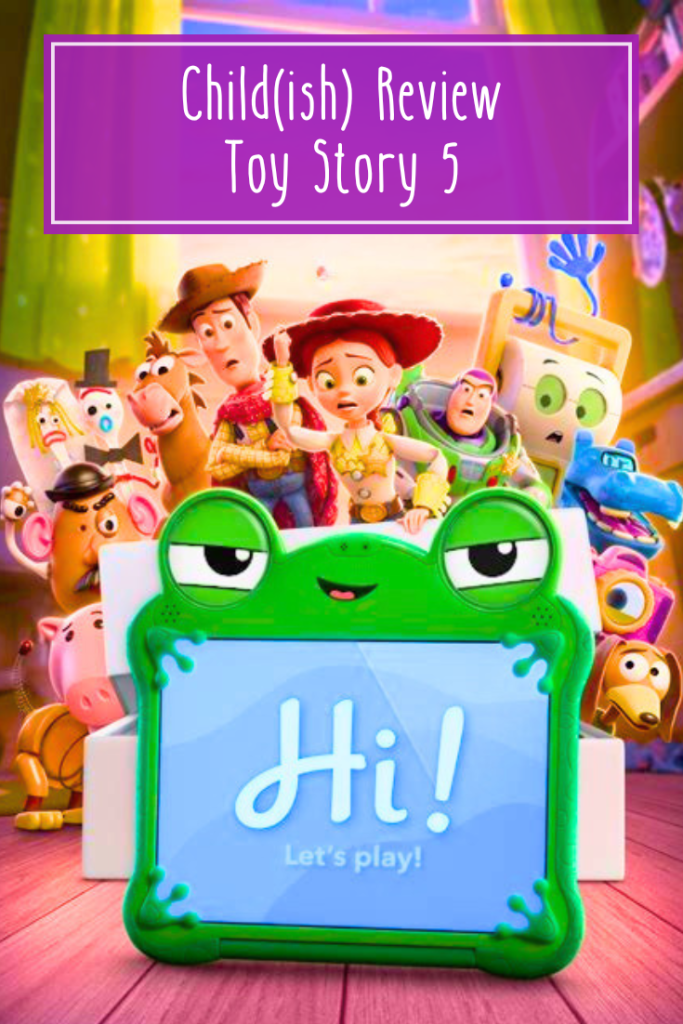
Child(ish) Review: Toy Story 5

I’ll be honest, I never really got into the Toy Story franchise. I know Woody, Buzz, and Jessie are beloved icons, but I just wasn’t into sitting down and watching the movies when they came out, and even now as a parent. So when Patti told me Toy Story 5 was coming out and I casually mentioned that I was indifferent, the gasp she let out was audible. For reference, the first Toy Story came out when we were 10.

But then the Toy Story 5 trailer dropped, Lilypad appeared on screen, and suddenly I was fully invested. In this installment, Bonnie is introduced to a new high‑tech tablet which completely disrupts the balance of playtime, forcing Jessie, Bullseye, Buzz, Woody and the rest of the gang to confront what it means to matter to a child in a digital age.

Toy Story 5 is essentially a child‑development case study wrapped in a Pixar movie. The film directly tackles themes that map onto core developmental domains: social-emotional growth, imaginative play, peer relationships, technology use, and the psychological experience of being “enough.”

Continue reading

Kids and the Concept of Love

“I’m in love.”
“No, you’re not. You don’t know what love is. You love cupcakes and ponies.” – Steve Byrne, The Byrne Identity

Kids are funny when it comes to love. Adults see it as a deep emotional connection, but children are still figuring out what that feeling even is. They might say “I love you” to a parent, announce plans to marry a playground friend, or juggle “relationships” with multiple classmates. They hug with their whole bodies and may even offer a kiss simply because they don’t know another way to show affection.

Kids may not fully grasp what love means, but they’re learning how it feels, how to express it, and how to set safe boundaries—and that learning begins from the moment they’re born.

Continue reading

The Girl Brain

While working at a pediatric clinic, seasoned therapists often noted that boys responded best to clear expectations and consistent consequences, while girls benefited more from patience, emotional connection, and time to process instructions and feelings.

When I was just starting out, I assumed all kids processed things the same and saw girls’ need for patience as coddling. For context, I was raised in an Asian household where emotions were seen more as a weakness than an asset. So, if you had to cry, go outside.  

With time however, I realized I was wrong. It wasn’t that they didn’t understand the task; it was that they wanted to get it right so badly. Sometimes they’d miss the mark on the first try, or they’d misread my tone and think I was upset with them. Other times, they were simply grappling with the fact that there was no room to negotiate the task or the consequence. What they needed wasn’t leniency—it was time, clarity, and emotional safety. Check out this IG video.

We know that boy and girl brains are different, but what are the actual characteristics a girl brain and makes it’s learning processes distinct from its male counterpart?  

Continue reading

The Boy Brain

Ever since my son was in daycare, I’ve heard “boys will be boys” tossed around. This was mostly to explain his energetic, impulsive behavior, especially during play or social interactions. I’ve never liked that saying. It felt like a shrug, an excuse, as if rough-and-tumble behavior is inevitable or exclusively male. And let’s be honest, girls can stir up just as much chaos as their male peers.

But as he moved into elementary school, the patterns became harder to ignore. More boys in his grade were on medication for ADHD. More boys were getting flagged for disruptive behavior. The gap wasn’t just anecdotal anymore. It was showing up in classroom dynamics, discipline charts, and parent-teacher conferences.

Recent research confirms that there are differences between male and female brains, but I keep wondering: Are those differences present before puberty? And if they are, how much do they actually shape the way boys and girls learn, connect, and navigate the world around them?

In this two-part series, we’ll explore how brain development may diverge between boys and girls, and how we can best support them as parents as they grow. First up: The boy brain.

Continue reading

The Art of Making Friends: Kid Edition

Humans are social creatures. For that reason alone, the way we engage and connect with others in different social contexts is an important occupation in everyday life. In occupational therapy, social participation refers to meaningful interactions with others in ways that foster emotional growth and confidence. For kids, it shows up in how they play with peers, take part in school and group activities, and how they form and maintain friendships.

Social skills span a wide and nuanced range of abilities that are a fundamental component of social participation. When it comes to friendships, they hinge on a set of social-emotional traits that help kids connect, resolve conflict, and build trust over time. These include:

Continue reading