
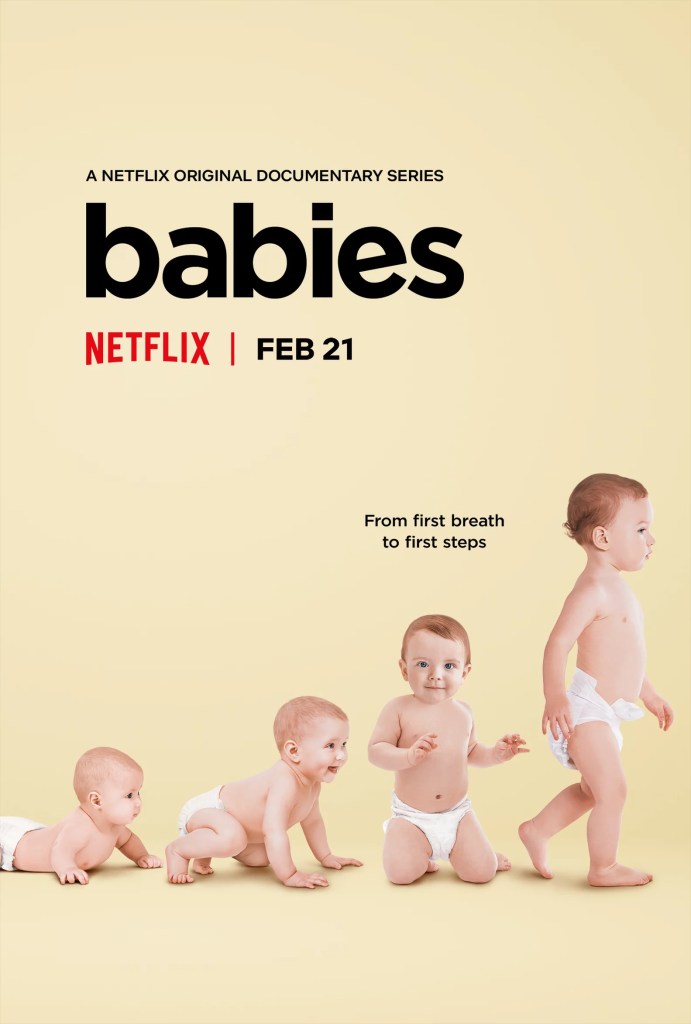
I enjoy good documentaries and Netflix has an abundance of them out right now. So when I came across the docuseries Babies, I had to check it out for the blog.
Babies explores the new research surrounding child development within the first year of life, following 15 newborns from around the globe. While I’d like to think I’m pretty well informed in this arena, there is still a great deal that I didn’t know and that was quite refreshing. It would be crazy to think that what I learned in grad school about babies 15+ years ago hasn’t been challenged or expanded upon since.
What I found interesting is the amount of research that has changed what we know about babies, even just in the last few years. Turns out infants have a greater understanding of their world and themselves than what we give them credit for. Some of these findings are quite thought-provoking as it goes against what I’ve been taught and practiced for years. But, that’s the beauty of science and research.
While there’s a ton of information to absorb from this docuseries, here are some interesting takeaways:
Dads and Oxytocin
We know that mothers have increased oxytocin (the love hormone) levels during pregnancy and remain high immediately following childbirth to boost the bond between mother and child. But what about dads? A study found that the father’s oxytocin levels were identical to the mom’s right after childbirth. In fact, the more caretaking the father did with their baby, the more oxytocin was produced to increase the bond.
The oxytocin surge is also responsible for activating the amygdala (the brain’s emotional and arousal center), priming us to stay vigilant of our child for LIFE. A mother’s amygdala is fully activated compared to the father’s, explaining why we wake up to our baby’s cries while our husbands sleep soundly. However, the dad’s amygdala can alter and fully activate if they are primary caregiver, as seen in gay couples or when the birth mother is not present. This tells us that being a parent is a choice and the brain can alter to care for an infant, if we so choose.
Bonding with Baby
The relationship we have with our babies and how we respond to them affect them greatly. The still-face experiment found that when a baby senses a disruption in the connection between themselves and their mother, they will try everything to gain their mother’s attention again. If that doesn’t work, they will self-soothe and trust that their parent will repair the bond. Additionally, infants who had good relationships with their mothers had lower cortisol levels and exhibited less stress during the experiment.
A similar experimental process was conducted to determine if babies are capable of joint attention (focusing on an object or event with someone else). Researchers wanted to examine a baby’s purpose with pointing. Are they pointing at something to share a moment with you or are they using the gesture for a simpler reason?
They discovered that babies stopped pointing when the adult engaged in the event (“Wow! Yes, it’s an elephant and he’s dancing.”) If the adult did not, they would continue to gesture towards the stimulus or try other methods to grab the adult’s attention to what they were looking at. So yes, when your 9-month-old is pointing at something, they’re trying to bond with you.
The ability to bond would mean that an infant would need some basic understanding of themselves in relation to others. Self-awareness for little ones does not occur until 18 months of age, or so we thought. A study revealed that at around four months, babies tend to engage differently with their own reflection compared to mimicking others. When looking at someone else, they are more attentive and smile more as opposed to looking at themselves in the mirror. This suggests that the emergence of becoming self-aware is happening a lot sooner than originally believed.
As babies transition from crawlers to walkers, their vocabulary skyrockets regardless of age. The reason is because of the qualitative differences with how parents interact with their bipedal baby compared to when they were just crawling around, allowing infants to obtain more language and have a better understanding of their environment.
Foodie Baby
Breast is best, but why? Studies have found that the mother’s milk changes to accommodate the needs of their newborn. For instance, mothers will produce richer, more energetically dense milk for sons and higher calcium-phosphorous ratios for their daughters. Breast milk production will also add antibodies if the mother’s body senses her baby is ill or will add whatever hormones or nutrients needed to help with growth and neural development. Now that’s some weird science on a biological level….
What moms eat during pregnancy and while breastfeeding can also influence their baby’s food preferences. A study found that infants who received carrot-flavoring via amniotic fluid in the womb or in breast milk enjoyed carrot-flavored cereal over plain cereal. Other studies have found that bottle-fed babies learned food flavors from their mother’s amniotic fluid. So, eat the foods you want your baby to eat. They may prefer it later.
Moving on Purpose
For years, it was thought that crawling served as a transitional milestone to walking. However, newborns have been observed creeping towards their mother’s breast within one hour of life or swimming/crawling in water right after birth. In 2016, a study found that 2-day newborns can propel themselves around using a crawling pattern while on a modified skateboard to support their heads. This suggests that babies are already primed for movement but can’t due to gravity. This also means that crawling is its own independent form of movement and not a predecessor to walking.
Another study draws a similar conclusion. The stepping reflex can be elicited in a newborn by holding them upright and supporting their weight as their feet touch a flat surface. However, the reflex disappears around two to three months. Researchers were curious to know the purpose of this involuntary response, is it connected to independent walking or its own separate phenomenon? They found that a toddler’s walk maintains the same movement patterns as newborns but is more refined. This means that babies are born with innate walking skills but can’t do it on their own until they gain more strength.
Despite the presence of reflexes and limited strength to fight gravity, a study discovered that babies are capable of making controlled movements (although not as refined). They do this by linking the sight of their arms to the sense of their movement, allowing them to bat at objects overhead or bring hands to their mouth with intent.
Other Interesting Tidbits
- Naps are important to a baby’s learning and memory. Research has found that if infants skipped a nap, they could not recall novel learned tasks compared to those who didn’t. Because their hippocampus (memory center) is small, they require multiple naps to consolidate and organize new information they’ve gained from their environment.
- Babies are born with selective morality. In one study, six-month-olds would frequently choose the helper over the hinderer, meaning that they have an innate grasp of right and wrong. However, another study expanded on this idea and found that infants would prefer the hinderer over the helper when they did not relate to the test object. It’s the idea of “the enemy of my enemy is my friend”.
- Walking alters the baby’s bone structure. When babies are learning to walk, they are laying down more bone on the sides of the legs to resist forces from toddling back and forth. By the age of five, the shape of a child’s leg bone starts to look like an adult’s.
- A baby’s vision is inadequate until 5-6 months of age. But, during that time frame, they can only make out faces. A theory for this is so that they can become familiar to the overall facial structures (eyes, mouth, nose, ears, hair, etc.) and eliminate the burden of processing any other visual details until later.
At the close of each episode, experts would give some advice to parents and, for the most part, all said the same things:
- Let your baby move and explore
- Expose your infant to new experiences
- See your child as their own unique person
- Be present and active in your baby’s life
- Trust your child and trust yourself
Sounds like great advice to me.
You can stream all twelve episodes now on Netflix.
Follow Child(ish) Advice on Facebook, Pinterest, Instagram, and TikTok.
 Child(ish) Advice
One thought on “Things I Learned on Netflix: Babies”