
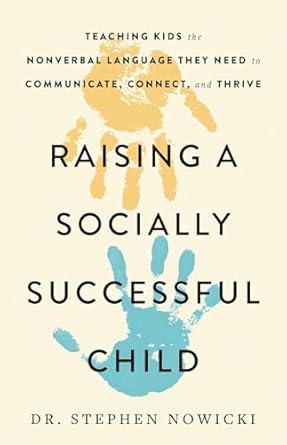
When we say “socially successful”, we mean making friends. Yes, how our child conducts themselves in public spaces in a way that is socially acceptable is one thing. Manners and etiquette are explicitly taught.
However, making friends is not exactly easy for most. Confidence, self-esteem, temperament; these all factor into the process personally. But then there is the reciprocation, the two-way street. Does this person like me back?
In Raising a Socially Successful Child, Dr. Stephen Nowicki explains the Friendship process; the different stages of how we start and maintain relationships.
The Friendship Cycle
The biggest development milestone of late childhood (ages 5-10) is having a best friend relationship. I mean inseparable, two-peas-in-a-pod, no one else matters best friends. Nowicki brought up a good point that up until elementary school, parents are generally the ones screening playmates. They are either cousins or the kids of their own friends. Once a child enters school, they get to choose their own friends for the very first time.
Choose – Based on someone’s nonverbal communication, we decide if we want to engage.
This could be as superficial as “she looks nice”, or as straight-forward as “they were wearing a shirt with a character I like” or “they smiled at me”. The same goes for adults. Maybe they laughed at a joke someone made, or they watch the same tv show, or they were reading the same book. Being in the same classroom or put on the same team expedites this process because there is more face time available and it gives them something in common.
Initiate – The first move. You point out that you have something in common, or you ask if they want to play something with you. In my experience, kids don’t quite introduce themselves first, they just jump in. Sometimes, depending on your kid’s temperament, they might not be confident to make that first move. After that, the reciprocating person takes in the verbal and nonverbal messaging and then decides if they too want to engage. They could still say no, again even for the shallowest of reasons.
Not gonna lie, this hurts; especially when you get older. You try to equip your child with conversation skills, or the right rules of engagement; but in the end, it’s up to them. If the person they are trying to initiate with isn’t biting back, or they aren’t in a place to be receptive to making friends, that is ok and not necessarily your kid’s fault. However, Nowicki shares some things that could be considered nonverbal turn-offs even for kids: not respecting personal space, talking or shouting, not talking turns, trying to assert authority or one-upping.
If you see these or get these as feedback, know that you can still work with your kids to adjust their behavior and help them read nonverbal cues better.
Deepen – Once you initiate the relationship superficially, like you know each other’s names, then you start to deepen the relationship. My kids have made a ton of “friends” on the playground but never manage to ask or remember their names. Safe to say those weren’t that deep.
Deepening is done through mutual trust, self-disclosure, acceptance, and mutual understanding. Both parties go back and forth talking about their interests, their personal feelings, their families. They are accepting of each other’s flaws and don’t judge. They spend a lot of time with each other, apart from the larger group. For the first time, they may be putting the wants and needs of someone else ahead of their own.
This shouldn’t happen with everyone your kid tries to be friends with. I agree with the author that you can really only have 1-2 truly deep friendships at a given time. A hallmark of this type of friendship is that kids start looking to their best friend for feedback about what they might be doing right or wrong: Did you think this was weird? Right, it wasn’t just me? You thought so, too?
Transition – Time passes.
You notice that once school ends for the summer, the relationship changes. Kids aren’t seeing each other every day at school. Play dates are further apart. If they aren’t in the same class the following year, maybe it’s a little different or maybe they pick right back up. Older kids can transition relationships a little easier because they have a little more reasoning and aren’t as dependent on physically being around each other. Once they get into middle and high school, there are more ways to connect (texts, social media).
For adults, this can happen as well. We move away, we don’t see each other as often. Face-to-face talking becomes texts and emails. But with time, deep friendships can survive the transition as long there is mutual understanding and effort.
Right now, I can see how my kids are building relationships. They each have two close friends from class and we make an effort to connect with their parents, invite them to birthdays and play dates, and even graduated to picking up gifts for them when we travel. While they are very much navigating their own relationships, I (the parent) still do minor course-correction as far as asking questions.
Similar to asking questions about empathy and feelings, you can help teach and model how to be a considerate friend.
“I noticed that you and Mia have a lot in common.”
“That was really nice of Thea to make a friendship bracelet for you.”
“Do you want to make something special for Everett for his birthday?”
“Who do you think might enjoy some of the cookies we baked?”
You can also talk and share memories about your own friendships to help illustrate how to be close friend.
Remember that your household is the baseline for verbal and nonverbal communication. If you have a loud, gesticulating house, your kid might not be able to pick up on the more subtle nonverbal cues of others. Conversely, if you have a quieter home, kids that are loud might be a turn off. There are lots of variations at home to take into account as well: Is your kid an only-child or are there multiple older/younger siblings? Different ethnicities and nationalities have different customs that affect nonverbal communication. You could probably also trace differences between kids with Gen X, Millennial, or Gen Z parents.

I hope you enjoyed this two-part Child(ish) Reads. We have one more week of kids’ social development content before we take off for Spring Break.
Happy Reading!
Browse here for more Child(ish) Reads.
Follow Child(ish) Advice on Facebook, Pinterest, Instagram, and TikTok.
 Child(ish) Advice