
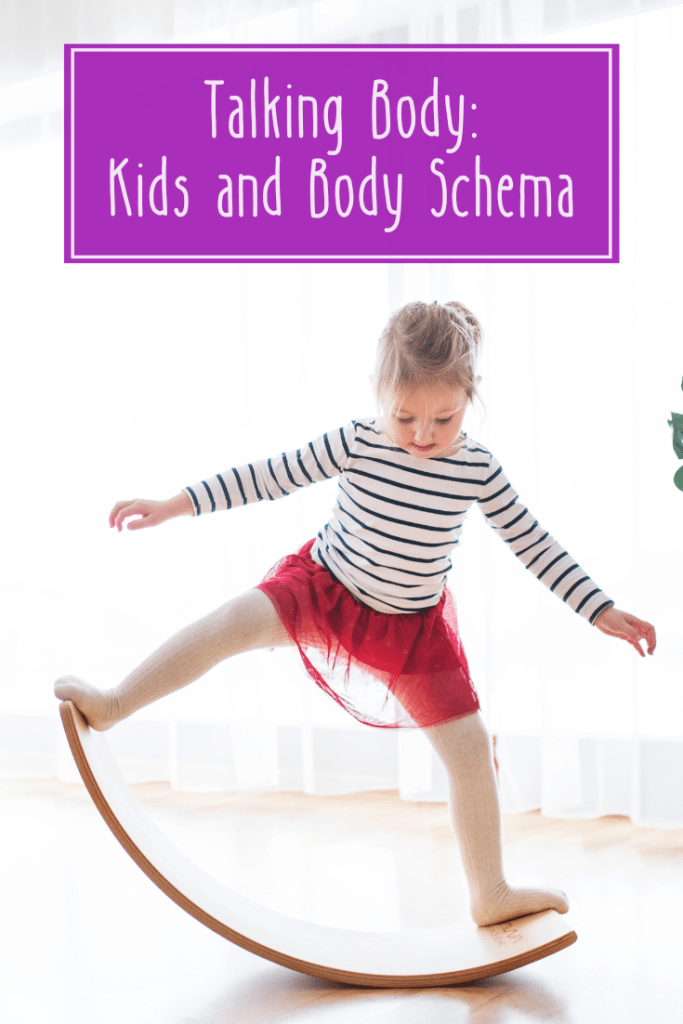
Kids have an enormous amount to learn, but before they can take on reading, writing, math, social skills, or even coordinated movement, they need a basic sense of themselves.
As children develop, it takes years for them to truly understand themselves—the “me I feel inside,” the “me others see,” and the “me I’m becoming.” That long process begins much earlier than most people realize. It starts when the brain first learns the physical boundaries of the body.
Those early signals (movement, balance, joint and muscle feedback, and deep pressure) are the “me sensations.” They give the brain its first clues about where the body begins and ends. Over time, these sensations fill in the brain’s internal “map of me,” the foundation for later self‑awareness, confidence, and coordinated movement.
This internal map is called the body schema. It’s the brain’s non‑conscious, constantly-updated model of the body, built from sensory systems working together. Body schema helps children know where their body is in space so they can move smoothly, coordinate actions, and interact with the world without having to think about every limb or joint.
Body Scheming
Body schema is a dynamic representation our nervous system maintains to track:
- The position of each body part
- The configuration of joints and segments
- The shape and boundaries of the body
- How the body is moving in real time
Body schema is important for kids because it underpins almost every aspect of physical, cognitive, social, and emotional development. When the brain has a clear, automatic sense of where the body is and how it moves, children can participate more fully in daily life, learn new skills more easily, and feel more confident in their bodies.
A well‑built body schema supports:
- A felt sense of safety and security, because the body feels predictable and organized
- Sustained attention, because fewer cognitive resources are spent monitoring the body
- Confident, fearless movement, because the brain can predict and control actions
- Automatic performance of daily motor tasks, without needing to consciously think through each step
Creating a Sense of Self
Three sensory systems play the strongest role in shaping the body schema. Here’s the quick review:
Proprioception – the system that defines body contents. Equipped with sensors in the muscles, tendons, and joints, it gives the brain that steady “this is me” feeling by sending constant feedback from muscle stretch, contraction, and joint pressure or movement. This helps the brain keep track of where each body part is and what it’s doing without needing to look. When this system is working well, it gives children a strong physical sense of themselves, which supports their growing emotional and psychological sense of self.
Vestibular – the system that puts “me” in my space. The vestibular system has sensors in the inner ear that notice how the head moves in every direction. This information helps the brain understand where the body is in relation to gravity, whether we are still or moving, how fast we are going, and which way we are headed. It also influences muscle tone, which supports posture and smooth, coordinated movement. When the vestibular centers activate, they help switch on the brainstem and increase the chemical activity needed for alertness and organization. This system helps children feel grounded and aware of “me in my space.”
Tactile – the system that helps define body boundaries. With touch receptors in and just under the skin, it helps the brain understand our body’s boundaries and tells the difference between light touch and deeper pressure. Light touch alerts the nervous system and signals the brain to pay attention. Pressure touch provides the calming “me” sensation and supports regulation. It also helps stimulate nerve growth factor, which supports healthy brain development. Because of these roles, the tactile system has a strong influence on learning and feeling secure in our own bodies.
These three sensory systems work together to give the brain the information it needs to build its internal map of the body, creating a strong physical sense of “me” and helping the brain and body function as a connected whole. However, if any of these systems are not working well, children may struggle with alertness, learning, and self‑regulation. They may also appear clumsy, have poor balance, or seem unsure of how to move through space.
Sensory registration is the brain’s ability to notice and take in important information, and it depends on having enough neural “wiring” dedicated to each type of input. When registration is strong, the brain gets clear signals that create a solid sense of “me in the picture,” linking physical sensations to a reliable sense of one’s own body. When registration is weak, those signals can feel scattered or incomplete, making a child feel as if their body doesn’t quite fit together and turning the world into a confusing rush of sensations. Other systems, like vision or hearing, must then work overtime to compensate, which can lead to fatigue.
Repeat Until Refined
The development of body schema reflects a core neuroscience principle: “What’s wired together fires together.” This phrase depicts how the brain learns through repetition. When two parts of the brain activate together again and again, their connection becomes stronger, faster, and more efficient. With enough repeated experience, those connections become well‑built pathways that support skills, habits, and automatic responses. When applied to sports or tasks, we call it “muscle memory”.
Body schema follows this same pattern. It begins before birth as the fetus senses movement, pressure, and early vestibular input, which start shaping the brain’s internal map of the body. After birth, repeated sensory‑motor experiences make this map more detailed and accurate, continuing to refine throughout infancy and early childhood and typically maturing around age 12. This slow, layered development becomes the foundation for how a child moves, learns, and feels in their body.
For example, a baby reaching for a toy shows how this map takes shape. Each time the baby tries to reach it, the brain blends information from vision, touch, proprioception, and balance to figure out where the body is and how to move it. With every attempt, the brain compares what it expected the movement to feel like with what actually happened. Over time, these repeated experiences strengthen the pathways that tell the brain, “This is where my arm is, this is how far I need to reach, and this is how my body moves as one piece.” Through thousands of these small moments, the child builds a more accurate, automatic internal map of their body.
Because body schema relies on the coordinated activation of sensory and motor systems, rich and varied movement experiences are essential for building a strong, reliable internal map.
A strong body schema supports:
- Confident, coordinated movement
- Efficient motor planning
- Balance and postural control
- Spatial navigation
- Independence in daily routines
- Participation in play and school activities
Because it integrates sensory, motor, and cognitive systems, it also lays the groundwork for later skills such as handwriting, sports, executive function, and social interaction.
Building the Body
We can help our kids develop body schema by giving them the kinds of repeated, sensory‑rich, whole‑body experiences that strengthen the brain’s internal sense of where the body is and how it moves. Body schema grows through action, feedback, and exploration, and the most effective support happens through everyday play and routines. Try these suggestions:
- Heavy work. Pushing or pulling wagons or laundry baskets, carrying groceries or cushions, jumping, crawling, climbing, and helping with chores like sweeping or raking.
- Whole-body play. Obstacle courses, running, tumbling, biking, scootering, swinging, sliding, and exploring uneven ground.
- Tactile and deep‑pressure experiences. Playing with playdough or kinetic sand, getting or giving squeezes or hugs, using body socks or stretchy resistance materials, and exploring sensory bins.
- Rhythmic and patterned movements. Clapping, dancing, marching, drumming, skipping, or jump roping.
- Mirror play and imitation. Playing copy‑cat games, trying yoga poses or animal walks, and making silly faces or body shapes.
- Tool use and fine motor exploration. Using crayons, scissors, tongs, tweezers, shovels, rakes, kitchen utensils, blocks, magnetic tiles, and activities like pouring, scooping, and stirring.
- Body parts and sequencing. Games like Simon Says, the Hokey Pokey, “touch your elbow/knee/shoulder” prompts, and action songs or finger plays. You can support early body awareness by simply naming body parts during everyday routines like diaper changes, dressing, and bathing. This steady, natural labeling helps children connect words with their bodies from the very beginning
- Sports. Early childhood is a great time to diversify a kid’s exposure to sports. Learning multiple team sports, martial arts, or dance/gymnastics (whether it’s on teams or just in the neighborhood) is great way to introduce skills and movement outside of everyday routine. Even for younger kids, kiddie soccer, swim lessons, or Mommy and Me classes can make sports accessible and not competitive. If a coach is there, you get the added benefit of structure, correction, and repetition. Be sure to stretch afterwards.
A strong body schema grows from everyday moments of movement, pressure, play, and connection woven naturally into a child’s routines. When children push, pull, climb, crawl, jump, carry, and explore their environments, their brains build the automatic internal map that supports confident movement, smooth coordination, and a solid foundation for learning new skills.
Like this post? Follow Child(ish) Advice on Facebook, Pinterest, Instagram, and TikTok.
Sources:
Mrm, R., & Rodrigues, M. (2020). A New Definition of Body Schema with Respect to Body-Centered Vs External Frames of Reference. Acta Scientific Neurology, 3, 2582–1121.
Sattin, D., Parma, C., Lunetta, C., Zulueta, A., Lanzone, J., Giani, L., Vassallo, M., Picozzi, M., & Parati, E. A. (2023). An Overview of the Body Schema and Body Image: Theoretical Models, Methodological Settings and Pitfalls for Rehabilitation of Persons with Neurological Disorders. Brain Sciences, 13(10), 1410.
NeuroLaunch. Body Scheme in Occupational Therapy: Enhancing Sensory Integration and Motor Skills. Oct 1, 2024.


One thought on “Talking Body: Kids and Body Schema”