
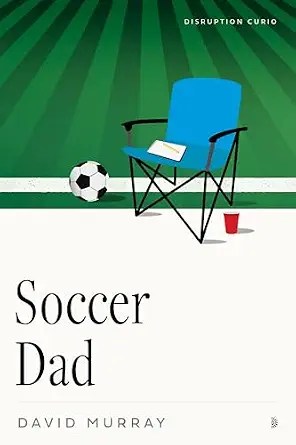
This summer, I had a super quick Audible that I really enjoyed. We’ve had several posts on navigating youth sports, from why they are awesome to how they can be detrimental. What I was missing was a non-biased first-hand parent account.
What I liked about this short memoir from David Murray is that he fully admits that he’s not “sporty”. He knew nothing about soccer. He wasn’t going to be a de facto coach, and he wasn’t going to push his daughter to uphold a family legacy. This is his parent story of how his daughter, Scout, started in kiddie soccer and followed her soccer goals all the way through her graduation at Ohio University.
Soccer Dad by David Murray.
Blurb: Soccer Dad is the story of a soccer-ignorant, sports-ambivalent writer who saw his daughter from the kiddie leagues through the travel-sports gauntlet to a coveted Division I scholarship. And then realized his work had only begun.
David Murray’s daughter, Scout, loved soccer from toddlerhood. Her drive and skill pulled the Murray family into the world of youth sports—one as culturally obsessive as it is economically exclusive, where each new achievement presents more challenges.
Youth sports is fun, but it isn’t simple—especially for parents determined to raise a rounded human being.
For my family, Aeris’ soccer journey is only about three years in and A&Z are both four years in for field hockey. But when you look at kids travel sports and the competitive landscape, there is a pathway should your kid (and household) choose to go down it. A very expensive, time-consuming, completely inconvenient pathway, but one that can lead to a fulfilling, elite athlete experience.
Here are my quick takeaways, and some quick segues into what I’ve been seeing in my feed.
Fun should come first
Scout stood out in kiddie soccer very early on. Whether this was through talent or enthusiasm, she caught the eye of parents and coaches. To repeat a sentiment from the blogosphere, “there is no such thing as an Elite 8-year-old.”
Standing out on a small team, where half of the kids are playing in the grass, isn’t hard. But we’re not talking about incredible ball-handling skills or game-winning strategy; we’re talking about just enjoying the game and trying their best. At this young of an age, a sport HAS TO be fun or else a kid isn’t going to want another season. That means having fun practices, fun coaches, making friends with your teammates, and getting their first participation trophy, regardless of how ridiculous it might be to you.
It’s also worth noting that winning is also part of the fun. It’s very hard to stay enthusiastic about a new sport when your team loses all the time. I can see this as a secondary reason to not keep score at early ages. In this case, winning is just making great, feel-good plays consistently.
Then comes the WORK
Once your kid decides that they want to invest their time with a certain sport, to see where it can take them, the executive function skills start kicking in. You see them being slightly more responsible with their equipment. They want to spend more of their free time working on skills in the backyard. They get excited to see older kids and adults play their sport. Cue in the FIFA craze from this summer and the back-to-back USWNT World Cup wins.
Aeris is right at this age. It’s not enough to just go to practice once or twice a week. We’re getting drills on YouTube to do at home. We have an hour of goalkeeper training right after 1.5 hours of team practice. For Z, that means going to additional “optional” practice to get more one-on-one time. This winter, I wouldn’t be surprised if there was some running or cardio “suggestions” for the off-season. The kids are being asked to up the game, and we can see some fall off from year to year.
Aeris is all in with it, even if she isn’t the best or fastest player in her age group, because she wants to get better. Incidentally, she was also chosen as co-captain of her squad. Troy and I are all in with it because it shows how commitment and effort can support or even trump natural talent. Z still doesn’t know where she falls.
From Murray’s perspective, he fell into the same parent category. He was in awe of Scout’s fearless drive and love of the sport. Their family had the means to support this passion, and they could see all the amazing ways soccer was supporting Scout. It gave her a die-hard team with unshakable friendships, confidence, and internal and external motivation.
Side note: Feeling part of a team is very important for girls. So many of my friends have daughters that have been playing with the same teammates for years, from soccer teams to dance teams. The inclusivity helps girls work and grow together, strengthening confidence, motivation, and the love of the sport. Think of all the little girls going to tournament or summer camps together in matching outfits…
Setting the bar higher and higher
This is the unfun part, the un-glamorous part. Once you get to a certain age or competition level, the commitment grows exponentially. For Murray, it was driving for hours roundtrip to practices, 2-3 times a week in addition to games. It was Scout doing homework in the car and living off fast food. It was leaving her local or high school team only to be put through the ringer on a more competitive, military-style club team.
Sometimes the coach likes you. Sometimes you’re made an example of. Sometimes you’re invited to workshops or showcases all over the country only to get no callbacks from collegiate scouts. And sometimes it’s Covid.
Even if you think you’ve gone down the right path, by your kid and by your family, it still might be the end of the road.
I’m glad that the book included this part of the journey because it shows just how many obstacles are on this path. More than just time, budget and skill, the emotional turmoil over things you can’t control, or the doubt and anxiety your kid feels, are all unavoidable. Scout has good years and bad years in the book. Sometimes she’s an amazing scorer who makes the Top 10 on ESPN. Other times she’s pulled out of a game and it makes her second guess.
As a parent, there isn’t much you can do besides having your talks at the ready. The “if you want to quit, we will support you” or “if you played your hardest, then that is enough” or “is this still making you happy”. Above all, it’s “how good of a player you are doesn’t matter to me as much as how good of a person you are.”
Is this the end?
The book is only a three-hour audiobook. It ends at the beginning of Scout’s senior year of college and reflects on 20 years of games, tryouts, and raising a kid. Murray shares anecdotes about other parents, road trips, and dealing with coaches. There are parents who try too much and those who just show up.
In the conclusion, he gives a quick rundown of lessons learned from being travel sports parent, from not letting your kid play up in older groups to not letting your kid head the ball to avoid brain injury. There are tradeoffs, dangers, and joys.
I liked his advice on trying a personal coach (very expensive but can make all the difference) and how to navigate more competitive leagues (ECNL, Girls Academy, etc. Also, very expensive but can make all the difference). I also loved his emphasis on the importance of having female coaches leading girls’ teams.
Most importantly, Murray writes about having a family sports ethic; not just creating a culture around a sport but establishing what is important. Whether that be hard work, chasing down a dream, finding inspirational athletes, a mantra to get you out of a losing mindset; it’s a touchstone to help you and your kid remember when you’re going through it.
I really liked this book’s perspective, and Soccer Dad is a great, quick read that will resonate with parents regardless of what sport or activity their kid plays. As I’m writing this, we’re also getting ready for our first travel field hockey tournament in Kentucky. These 8-year-olds are probably more excited about seeing Mammoth Cave, but they will have the opportunity to play other club teams and see some ranked college teams play. We’ll be there with our coffee, hotel breakfast, and fold-up chairs.

Browse here for more Child(ish) Reads.
Like this post? Follow Child(ish) Advice on Facebook, Pinterest, Instagram, and TikTok.

