
This book came out three years ago. I didn’t jump to review it because at the time, our kids were only 5. That’s a bit young to start worrying about achievement culture. Now, even though high school and applying to colleges are far off, there are still big parts of this book that speak to child development; both academically and personally.
The book also gives more nuance and research to our education system, and sheds more light on that pesky Gen Z: Cautionary Tale thing. It’s a great book to start your school year.
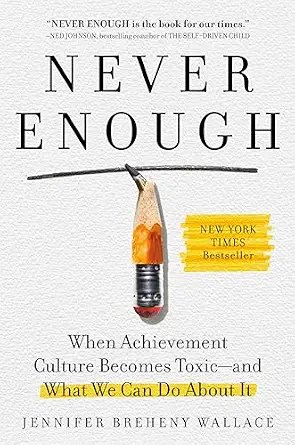
Never Enough: When Achievement Culture Becomes Toxic-and What We Can Do About It by Jennifer Breheny Wallace.
Blurb: The definitive book on the rise of “toxic achievement culture” overtaking our kids’ and parents’ lives, and a new framework for fighting back
In the ever more competitive race to secure the best possible future, today’s students face unprecedented pressure to succeed. They jam-pack their schedules with AP classes, fill every waking hour with resume-padding activities, and even sabotage relationships with friends to “get ahead.” Family incomes and schedules are stretched to the breaking point by tutoring fees and athletic schedules. Yet this drive to optimize performance has only resulted in skyrocketing rates of anxiety, depression, and even self-harm in America’s highest achieving schools. Parents, educators, and community leaders are facing the same quandary: how can we teach our kids to strive towards excellence without crushing them?
In Never Enough, award-winning reporter Jennifer Breheny Wallace investigates the deep roots of toxic achievement culture and finds out what we must do to fight back. Drawing on interviews with families, educators, and an original survey of nearly 6,000 parents, she exposes how the pressure to perform is not a matter of parental choice but baked into our larger society and spurred by increasing income inequality and dwindling opportunities.
So let’s round up the usual suspects:
The Kids: A Well-Rounded Spike
Every spring, I get a flood of TikToks from high school seniors sharing their college acceptances. They’re sharing graphics of their resumés, all their schools and acceptance rates, Ivies versus state schools, and so forth. What confuses me is the number of colleges they applied to.
What do you mean you sent out 30 applications? I sent six.
Why would you apply to an Ivy (let alone ALL of them) if you have significantly less than the range test score?
How many of these applications were based on reputation and not actual degree program?
What do you mean being an AP student/4-year athlete is only C tier?
In this book, Wallace begins with a call for empathy for this generation. The mix of high standards, competition, parental pressure, and playing a sheer numbers game has created a very toxic high school environment. Wallace gives day-in-the-life scenes from a handful of students so we can understand the demands these kids are facing:
8 hours of school
2-3 hours of homework and studying
2-3 hours of sports practices
2 hours of clubs
Working jobs or volunteering
On top of it, not eating or sleeping enough. Many kids also have passion projects and leadership roles, simply because it’s the extra level-up they need to get into a good college. “Seemingly, every minute of a child’s life is managed to maximize their potential.”
Wallace also interviewed many educational consultants and college admissions officers, all saying the same thing. Forty years ago, to get into college you just need to be good at something: a good student or a good athlete.
Twenty years ago, they were looking for students that were well-rounded: a good student who also played a sport, and was in the arts, and led student clubs, etc.
Now that well-rounded student must also have a “spike”, something that they founded or invented that is enterprising and quirky enough that it helps the community. This is where we see tons of preference for kids starting non-profits, or coding an app, or grassroots fundraising to solve real world problems.
Gen Z is also massively populated, making up 22% of the US population. All these kids going cutthroat to get into a shrinking number of colleges. Note that this doesn’t mention additional time spent online scrolling their personal life at 2am, making everything feel just that much worse.
This pressure to achieve has made students attending competitive, high-achieving schools an at-risk group for mental health risks.
The Parents: Is This Play About Us?
It’s easy to say that parents are the crux of the overall problem. However, it isn’t in the way you’d think. Our Millennial brain would go right to Freddie Prinze, Jr. in She’s All That, with his “You can’t fix your mistakes though me” diatribe.
In reality, for parents the culprit is social acceptance. Having a child who gets accepted to an aspirational school, who has an impressive resumé, who gets a successful job right away; this is a status symbol. It’s a sign of a “good parent”. Thumbs up! Good for you.
So to get that, parents spend tons of money to build said resumé, to grant these experiences, to curate a successful young adult starting at an early age. This guarantees that by the time you retire, you would have responsible offspring that you don’t have to worry about financially. Because money equals happiness and money is getting scarcer with each generation, kids are becoming more and more of an investment. This doesn’t bode well for a kid who feels that they are a project and not a worthwhile person in their parent’s life.
This race to become the best parent, to give your kid the best possible chance, to make your kid the most stand-out, also creates competition amongst parents, spilling the toxic culture onto even more people. To add insult to injury, while parents are paving the way for their impressive students; they are not asking them to do chores or modeling how to take care of themselves. So while you have a kid who is deep in Calculus BC, they also don’t know how to make mac and cheese.
So how do we get over ourselves? Redefine what success and happiness really mean, and realize that our kids are not an extension of ourselves.
The Teachers: They Matter
We’ve written before about making your teacher part of your kid’s team, and for good reason. They are important people in your kid’s life and in your village. Next to home, school is the second most important place in a kid’s life and teachers play a big role in a child’s sense of self. A great teacher can give kids confidence, relieve pressure, reaffirm that they matter. Teachers also have the ability to shut down a kid’s confidence, reaffirm a negative voice instead of a positive one, or base a kid’s worth off their academic performance.
A combative parent can easily shut down the self-worth and mattering of a teacher, and that in turn can shut it down for the student. No one wins.
Helping your teacher feel seen and valued creates better, happier teachers, which makes for better, happier classrooms. School becomes a second home/safe space for the kids as a community and that means more trusted adults showing kids that they are valued. In turn, the toxic achievement pressure disappears, and students perform better with resilience and self-worth.
In addition, a teacher can diffuse toxic competition in their classrooms. They can encourage collaborative environments, communication and relationship-building amongst students, and do away with a zero-sum mindset of your win equals my loss.
The Importance of Mattering
Mattering is by far the most important thing about this book. It is so ever-present that Wallace wrote an entire second book on Mattering for adults. Mattering is the feeling that we are valued and have an opportunity to add value. Key ingredients to mattering are feeling significant, feeling appreciated, feeling invested in, feeling depended on.
And what does that mean for kids? It means knowing that they are valuable members of a family, group, or classroom. That they are not only part of a team, but they contribute to that team’s success. That their value is unconditional, that they are irreplaceable, and that they make others feel valued as well.
This does not mean spoiling, or love bombing, or feeding constant praise. It also doesn’t mean never holding them accountable. “I’ve even stopped telling my kids that I just want them to be happy. Happiness and well-being, I’ve come to realize, are the by-products of living a life where we feel valued, and add value to others.”
The book has a resource chapter at the end that shares small changes parents can implement at home to help create an environment of mattering and belonging. This means modeling and deepening healthy relationships, creating safe spaces and safe people, being helpful, having conversations about things other than academic or athletic performance, and planning playtime, downtime, and family time every day. You can relieve the sources of stress, as well as model healthy coping strategies for stress.
Like a true reporter, Wallace brings in the research stats, surveys, and related reading to build a case for shutting down the culture of toxic pressure in our kids lives. She gets into the neuroscience of prolonged stress with lasting consequences even after students get into college.
The book’s chapters alternate perspectives between kids, parents, and teachers, showing how all three play a role in this achievement culture. Wallace also goes into schools and teachers who have built communities to combat the toxicity. Things like building a school community culture, taking lessons from sports into the classroom, or using volunteering as a grounding are all positive ways to reinforce mattering.
This is a great resource if your kid is starting high school. Even in middle school, there is a lot of noise about what academic track your kid will need to be on. For Millennial parents who seem like we are constantly in a cycle of course-correcting and repairing, this fits right into a lot of the things we’re establishing in early childhood: building resilience and empathy, applauding effort over final results, learning that it’s okay to ask for help, teaching that they are a part of something bigger, etc.
At a time where all four years of high school are under a microscope, these mindset tweaks should adjust how we support our kid’s academic career as well as their actual adolescent development. By relieving the pressure of toxic achievement, we are in turn helping them become healthier, more capable humans.

Browse here for more Child(ish) Reads.
Like this post? Follow Child(ish) Advice on Facebook, Pinterest, Instagram, and TikTok.

