
It’s the last week of the school year and the last posts before our annual summer blog break. So we’re keeping it fun with a playdate review.
With the kids getting older, there isn’t much that they haven’t tried. So, play dates have been harder to brainstorm and plan. One of the first things I wanted to do when we came up with this blog series is wheel pottery. I had never done it before, and the girls have done kids clay sculpting classes many times. Now, all three kids are finally old enough to take it on.
Most pottery wheel studios have a minimum age for their beginner wheel classes, or they want you to buy several sessions or weekly course. In my cursory Google search, I found Mudfire, an open community pottery studio built around creativity, inclusivity, and shared space. They offer single Wheel 101 and 102 classes, capped at 12 people with a minimum age of 6 years old. They also have kids summer camps and special kids-only pottery wheel classes starting in June.
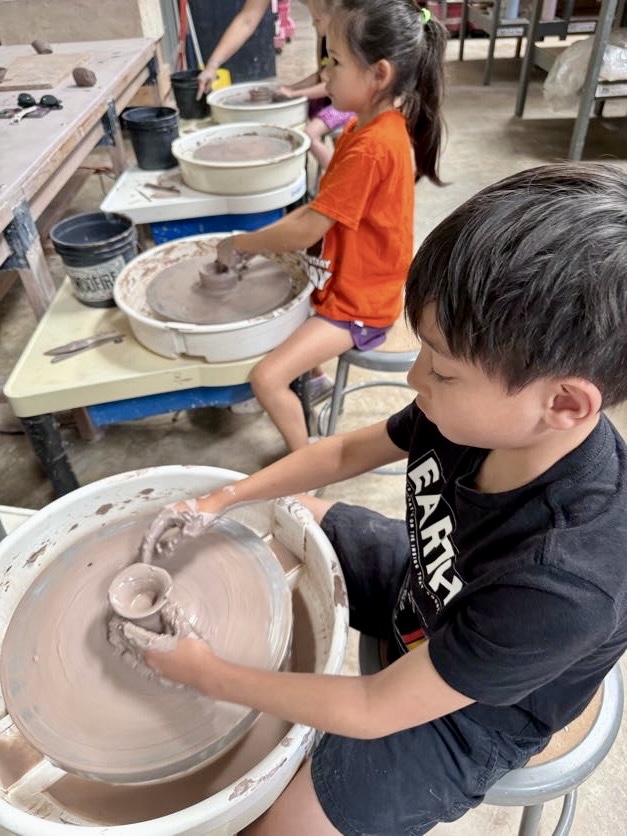
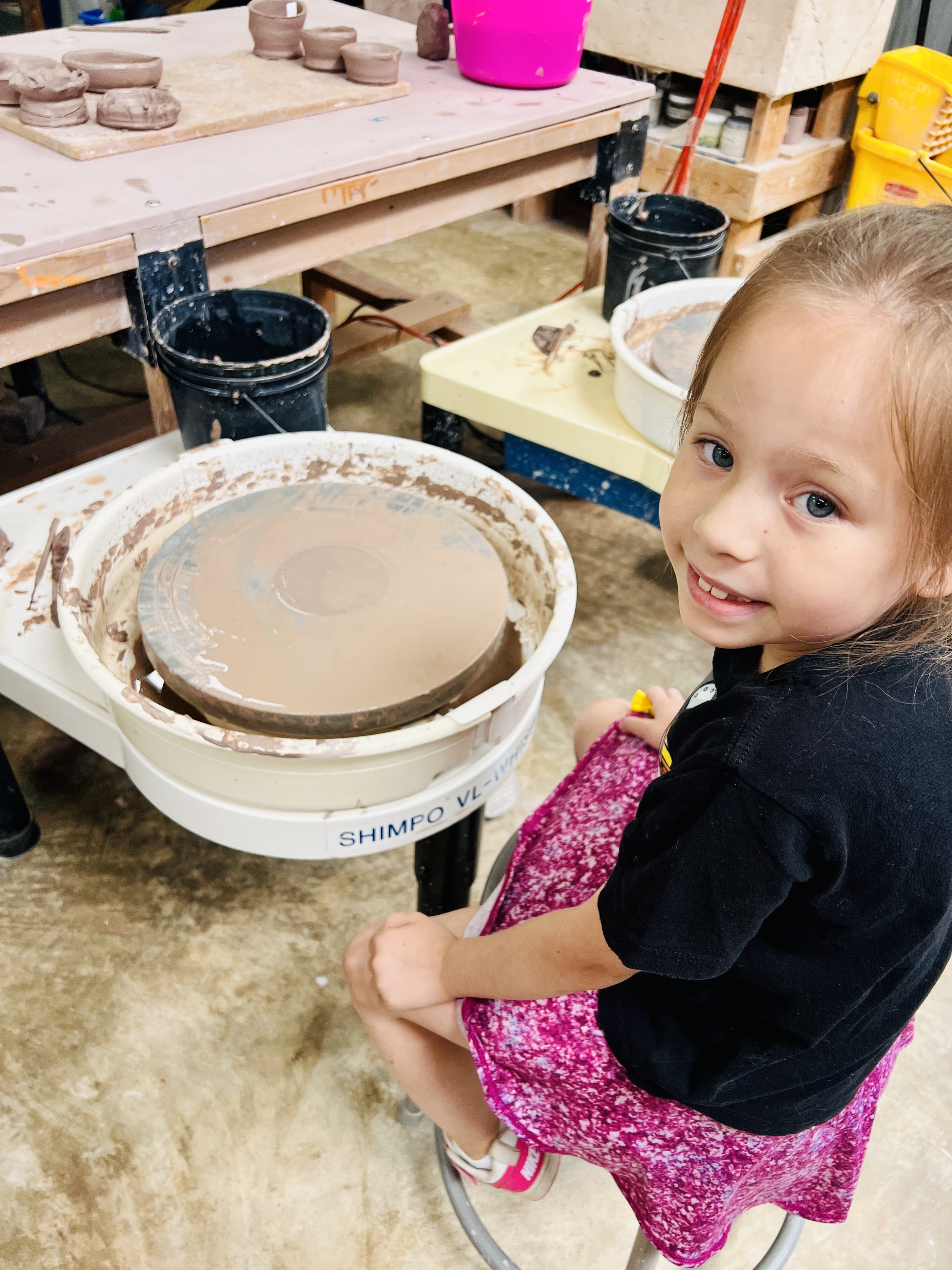
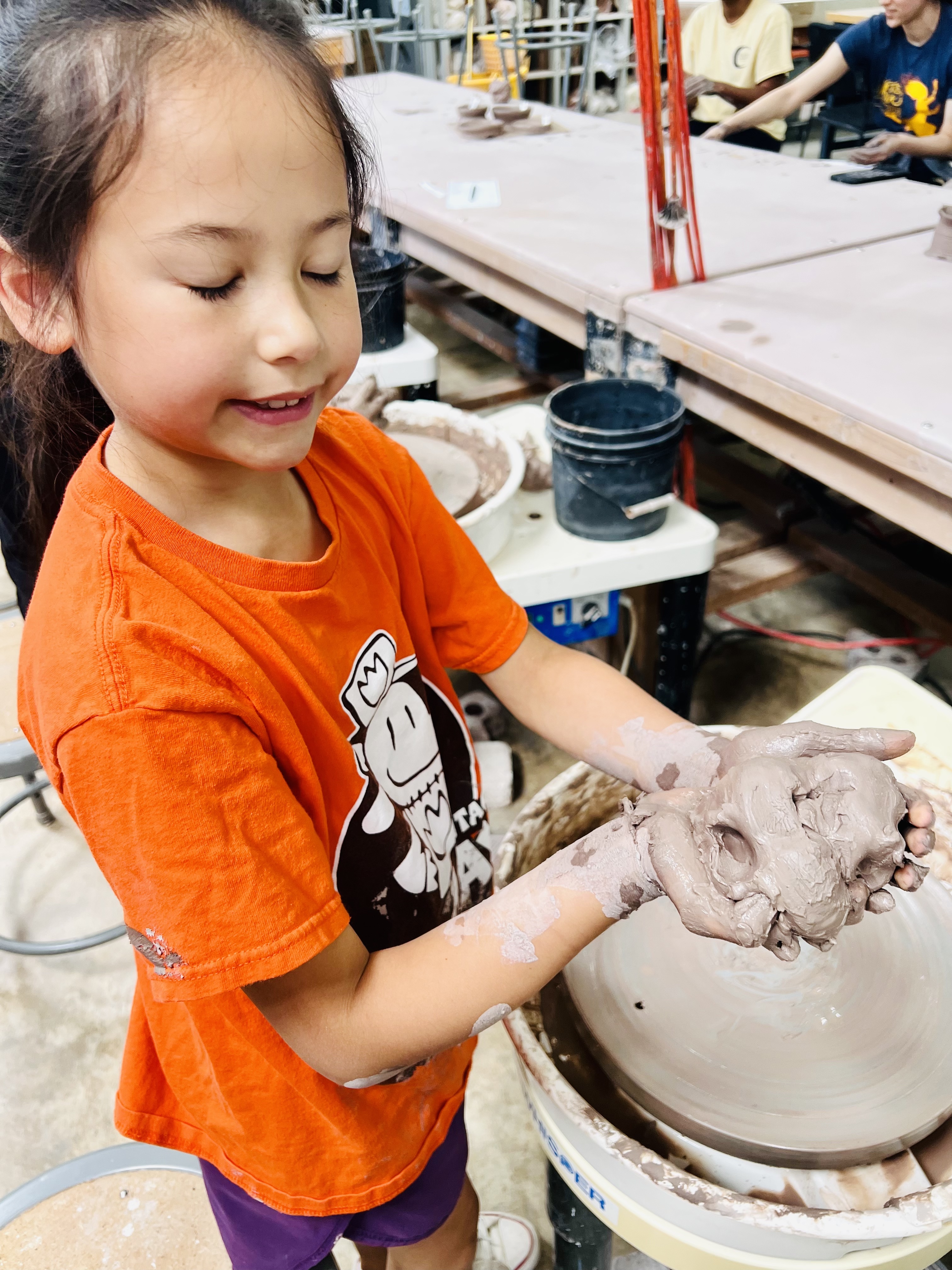
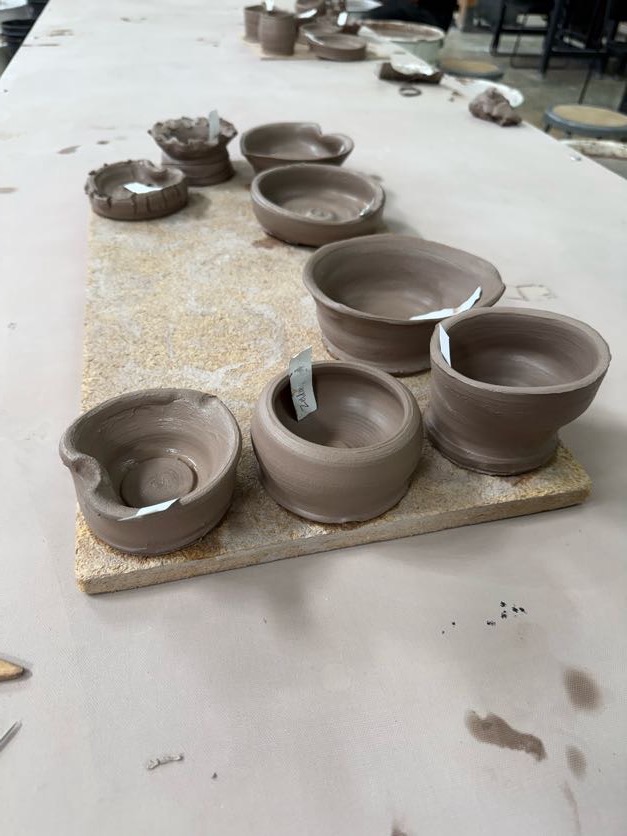
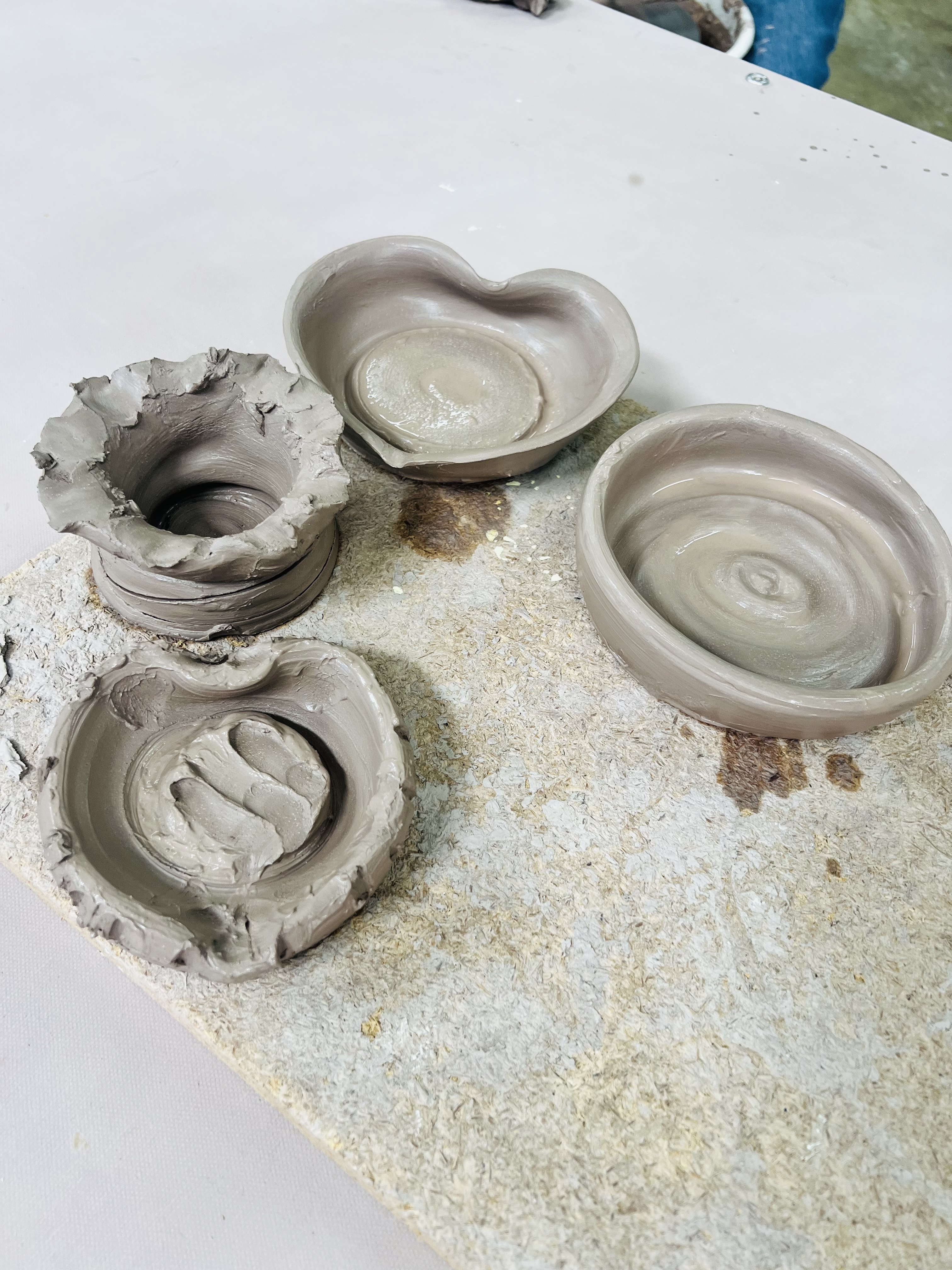
Mary and I signed up for a regular Wheel 101 class, so all five of us got our own wheel space and two instructors guided us on how to make a standard bowl. Included in the price are two pieces that you get to take home, so you can experiment with different sizes and techniques for the two hours and keep your best two.
OT Part
Ceramics and clay work give kids a whole‑body, whole‑brain developmental workout, and the research-backed benefits are surprisingly deep. It strengthens fine motor skills, builds focus and patience, supports emotional regulation, boosts confidence, and enhances problem‑solving and spatial reasoning. It’s also a powerful sensory activity that helps kids calm their bodies and express themselves without words.
Wheel throwing (working on the pottery wheel) is the next level up. A pottery wheel allows a potter to form symmetrical, rounded pieces (bowls, cups, vases, dishes) by spinning clay and shaping it with their hands. The spinning motion creates even walls, smooth curves, and consistent thickness which can be nearly impossible to achieve by hand alone. From a developmental standpoint, the wheel promotes:
- Bilateral coordination. Kids must use both hands together while each hand performs a different task, which is a major skill for building strong brain‑body connections. The pedal that regulates the speed of the wheel is like the gas pedal on a car. So in addition, the kids needed to coordinate their feet and adjust for pressure/speed.
- Fine motor precision and pressure grading. Clay on the wheel pushes back, so kids must constantly balance gentle versus firm touch, as well as make tiny, precise adjustments as the clay spins. These demands strengthen the same foundational skills they rely on for handwriting, tying shoes, and using everyday tools. Don’t forget the hand movements also need to be tied to the body, so they are using their core, posture, and muscle to keep their techniques steady and uniform. It’s an interesting mix of having to bear down on the clay, but be gentle and controlled at the same time.
- Sustained attention and focus. Working at the wheel asks kids to stay still, be patient, and remain with a task for several uninterrupted minutes. The rhythm of the process naturally encourages concentration, making the wheel a built‑in attention trainer.
- Sensory regulation. The steady spinning, rhythmic hand movements, and the feel of the clay create a deeply calming sensory combination that helps settle and organize the nervous system.
- Cause and effect. The wheel gives immediate, nonverbal feedback, which helps strengthen problem‑solving skills and teaches kids how their actions directly shape the outcome.
- Confidence and mastery. As kids shape the clay and watch their work take form, they experience a sense of competence, pride, and the thrill of creating something functional with their own hands.
Kids might love the idea of playing on the pottery wheel, but using it is surprisingly hard. Their hands may not be strong enough, their coordination may not be fully developed, or their nervous system may become overwhelmed by the speed, pressure, and sensory demands. It’s a big task for a small body.
- Physical skills are still developing. Bilateral coordination is still developing in young kids, and for many, especially for ages under 8, using both hands for different tasks can feel like patting your head and rubbing your stomach while balancing on a wobble board. Their hand strength and graded pressure control are also still maturing, which means they often push too hard and collapse the clay or too softly and make no progress. Add in core strength and posture challenges, and kids with low tone, weak core muscles, or immature postural control fatigue quickly at the wheel. There aren’t that many sports or activities at this age where you would naturally learn fine motor and locked full body muscle connection (rowing, weightlifting, golf, etc.)
- And so are their executive functions. Wheel throwing requires sequencing steps, noticing small changes, and making adjustments. These are high‑level skills that continue developing well into adolescence.
- And so is their frustration tolerance. The wheel is not instant gratification. Clay collapses and tears. Like, a lot. Kids who struggle with perfectionism, impulsivity, or emotional regulation may find this especially challenging and can become overwhelmed before the clay even gives way. Even Mary and I had at least 3-4 attempts that tore and we had to smush it and start over.
- Sensory overwhelm. The wheel adds a lot of sensory input all at once: spinning motion, vibration, cold and wet clay, messy hands, and background noise. For sensory‑sensitive kids, this can be dysregulating. For sensory seekers, it can be overstimulating.
- Size and strength mismatch. The wheel is designed for adult bodies, which means kids often can’t reach comfortably, brace their elbows, stabilize their arms, or control the pedal with ease. The basic ergonomics work against them, making the physical setup itself an added challenge before they even begin shaping the clay.
The Parent Part
Mary
My 9‑year‑old was genuinely eager to try the pottery wheel. He has enjoyed creating clay sculptures in his art class, and the idea of making something on the wheel felt like an exciting next step. When we arrived at the studio, he explored the space with interest, examining the different clays and glazes and taking in the environment. He listened carefully during the instruction portion and seemed fully prepared to create something he would be proud of. And then, we hit our first snag.
While he was able to straddle the equipment and sit correctly at his station, he struggled to apply enough pressure to control the wheel’s speed. Once the instructors adjusted the pedal for him, he was able to get started (sort of). His project began as a cup, morphed into a vase, and then slowly transformed into something resembling a volcano. His imagination was endless, but the clay had been overworked to the point that it could no longer hold its shape. Instead of asking for help, he tried to troubleshoot on his own, which quickly led to a collapsed mound of clay and a very frustrated child.
As his emotions escalated, the steps from the demonstration became harder for him to recall. The messier the clay became, the more overwhelmed he felt. By the end of the two‑hour class, he didn’t have a piece ready for the kiln, and he was devastated. Although the instructors kindly offered to create a form for him to glaze, he declined. In a last‑minute effort to leave with something he could feel proud of, he used his remaining clay to sculpt a small creature to take home. His own improvised parting gift, if you will. Despite the disappointment, he expressed interest in trying again.
Patti
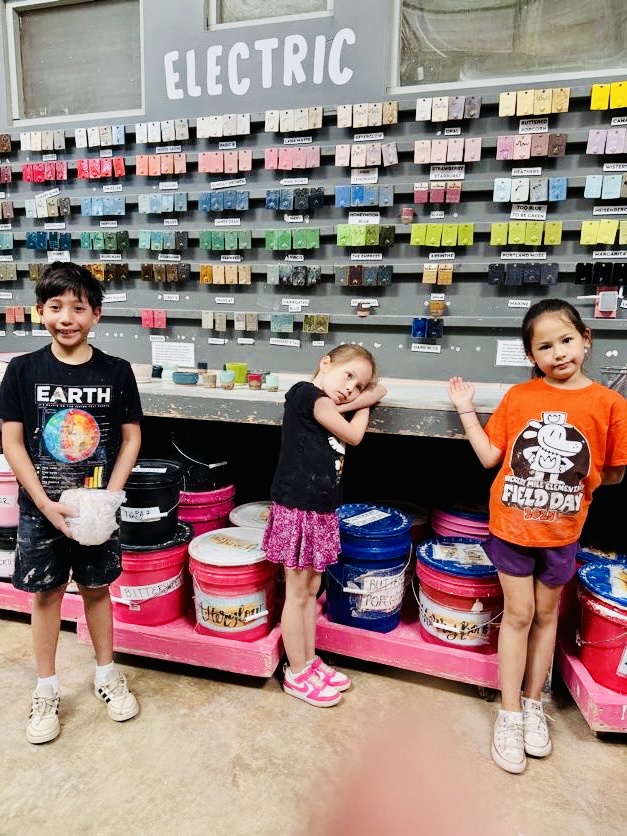
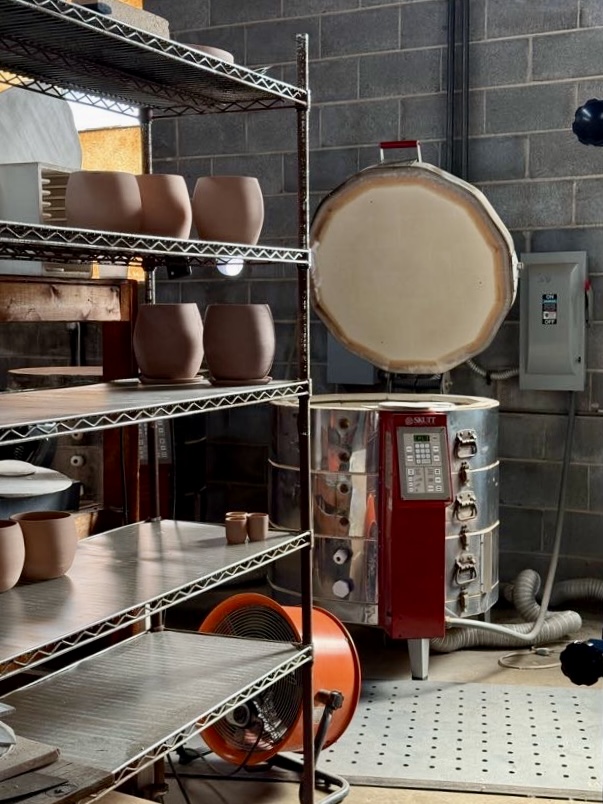
The classes start with a short tour of the facility, including the kiln and the color wall. From there, they talked about the brown-speckled clay we would be using. The kids learned about the chemistry of the clay and the kiln, the physics of the wheel, the importance of using water but not so much water.
I don’t think the girls (or any kids their age for that matter) have a ton of experience with applying controlled pressure. Watching them attack Play-Doh or slime is one thing, but subtlety is learned. They said that the wheel pedal works just like the gas pedal on a car, but it’s not like our kids would know what that feels like. So just like your first driver’s ed lesson, it’s a bit jerky.
My first in-process observation was that the girls just liked touching the clay. They would go minutes just letting the clay spin in their hands, not shaping it. The starting clay is much harder than the cloud clay you can get off the shelf. You need water to make the clay more pliable, but it can get messy fast. I’d see their eyes wander, too and have to reel their attention back in.
There were also some additional tools they gave us for shaping the clay, including a pointy needle tool meant to measure the thickness of the clay base. If the piece is too thick, you can’t fire it. If the walls or base is too thin, you can’t fire it. I caught them mishandling the tool one too many times for my comfort, so I made a habit of giving them verbal safety checks. (Where is your sponge? Adjust your body. Give it a little water, the clay looks dry. What’s the next instruction? Is your clay in the center?) Between the wheel and the clay, it took some time to figure out the “just right”.
I also reminded them a few times to ask for help if they looked stuck or frustrated. Not just quietly raising their hand, but communicating aloud what they needed. The instructors were amazing at helping and assessing, making quick corrections or repairs, and taking your piece off the wheel. They were also really generous to give us additional clay when ours got too muddy and overworked.
One thing that would’ve been helpful is if the girls had drawn what kind of vessel they wanted to make before we started spinning. Everyone starts out making a bowl/trinket tray/ashtray, but the second piece is a free for all. I think the kids wasted a good bit of time because they didn’t quite know what they were looking for. I will say the heart-shaped bowl was a favorite.
I do think the kids would want to try it out again, so this was a good introduction to the medium. Although, they all looked like they’d been through the ringer once the class ended.
Things to Keep in Mind:
- Observation isn’t allowed unless you’re enrolled in the class. Luckily, they had spots available for all five of us. From their website, the kids clay classes and camps are drop-off only. Other studios may have different rules, so double check.
- The instructors are happy to help, but they typically wait for the students to ask. This helps them build confidence and independence at the wheel.
- It’s best to reframe the expectation (for you and your child). While the goal may be to create something to fire in the kiln, it’s really an introductory class to learn basic wheel techniques and rules. Some things are easy to execute, others need ample practice.
- The classroom setup doesn’t allow parents to assist hands‑on the whole time. Kids have to try the techniques themselves, which is part of the learning process and keeps everyone safe.
Verdict: Recommended for older kids.
Clay work in any form is wonderful for kids. The wheel adds layers of challenge that hand‑building or general clay play simply don’t. The pottery wheel introduces more complexity, which is why many children benefit from starting with hand‑building and then “graduating” to the wheel once their bodies and brains are ready for the added demands. Definitely note any age requirements, and be ready for really muddy hands.
Browse more Playdate Reviews.
Like this post? Follow Child(ish) Advice on Facebook, Pinterest, Instagram, and TikTok.

