
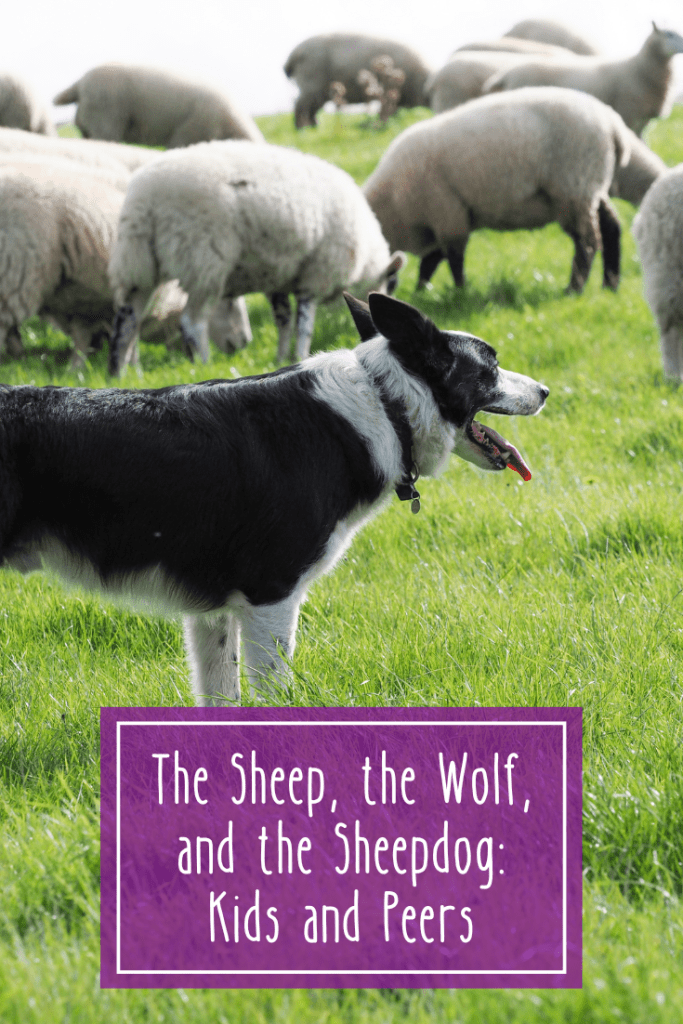
There are three types of people in this world: sheep, wolves, and sheepdogs. – Wayne Kyle, American Sniper
My husband has used this analogy to explain certain types of people to our son ever since he was little. Granted, it is an oversimplified explanation of human nature, but it gets the point across. In our version of the metaphor, sheep are those who cannot defend themselves when harm comes their way, wolves take advantage of their vulnerability, and the sheepdog stands up and protects the sheep. It’s a visual way to tell him to be a decent human and not be a d*ck.
While our son has long understood this concept, it’s becoming harder for him to follow. In fact, it feels like he’s exhibiting more wolf-like behavior these days. Turns out the shift between sheepdog and wolf mirrors the growing complexity of his social circle and how kids his age are dealing with the next level of social skills and challenges.
Social Circuits
Between the ages of 6-12, kids start grasping more complex ideas like loyalty, fairness, and group dynamic.
They are learning to:
- Manage emotions – regulating feelings like frustration, sadness, and excitement
- Cope with stress – identifying stressors and use basic strategies to handle them
- Understand perspectives – having empathy by recognizing other POVs
- Build relationships – making and maintaining friendships, understanding social roles, and showing affection and appreciation for others
During this stage, friendships and peer relationships begin to play a more central role in shaping a child’s sense of identity and behavior. They start comparing themselves to others and become increasingly motivated by the desire to be liked and accepted. Peer feedback carries more emotional weight, making them more self-critical and sensitive to social cues. As their emotional awareness deepens, children form stronger, more nuanced friendships and begin handling interpersonal conflicts with greater skill.
Making and keeping friends becomes a source of reward for kids. Neuroimaging studies using fMRI reveal that interacting with friends activates regions like the ventromedial prefrontal cortex (the rational decision maker) and ventral striatum (the reward center hub). This heightened activity suggests that friendships hold emotional significance and offer social gratification. These brain areas also help children differentiate between friends and other peers, promoting prosocial behaviors such as sharing, empathy, and cooperation.
The Difficulties of Being a Sheepdog
Young children generally develop a clear sense of right and wrong early on. They recognize that actions like hitting, kicking, biting, or using hurtful words cause pain and goes against what they understand to be fair and kind. But as they get older, some of those clear, moral lines begin to blur. Kids may start engaging in mean behavior, even condoning it, despite knowing better.
For example, my son has always been the one to stand up for his friends, especially when someone was picking on them. Lately, though, I’ve noticed a shift. He’s sometimes the one disrupting games or conversations, or he has stood by while others mocked his friends. I KNOW I raised him better than that. While we may not expect our kids to be sheepdogs 24/7, we don’t expect them to be bullies or tolerate friends getting hurt. But despite that notion, there’s a reason behind the behavior.
Wolf-Like Tendencies
Kids can be mean to one another, and it only gets more vicious as they get older. This brings in “hurt people hurt people.” In the case of kid-on-kid conflict, some reasons include:
- Impulse and emotional regulation. Meanness can be a quick emotional outlet when they feel overwhelmed. For my son, the hurt and frustration he felt from being told he wasn’t “good enough” or “cool enough” to hang out with certain cliques caused him to immediately respond with anger and wreck whatever activity the “cool kids” were engaged in (it was his way of getting back at them).
- Selective empathy. This is when someone temporarily suspends consideration for a certain person or group, determining that their feelings don’t count because they come off as annoying or weird. This allows them to justify their unkind behavior.
- Social comparison. Kids sometimes resort to unkind behavior as a way to elevate their social standing or avoid being left out of a group they admire; trying to assert themselves as an Alpha but in a more-aggressive, overt way. This behavior can often be rooted in deeper feelings of insecurity, a desire for attention, or a need to assert control.
- Modeled behavior. If kids are frequently exposed to aggression (whether at home, among friends, or in the media), they may imitate it without understanding the impact.
Sheepish Behavior
No one wants to watch someone get picked on, but standing up to someone can be incredibly tough for kids because there is more at stake.
- Fear of conflict. Speaking up will lead to confrontation and might escalate the situation, becoming a target for aggression as well.
- Power imbalances. Bullies or dominant personalities can make others feel powerless, especially if the child hasn’t developed ways to be assertive. Think fight vs. flight vs. freeze, with more kids going the freeze option.
- Unclear boundaries. Children are still learning what’s acceptable behavior and may not recognize when someone crosses the line. My kiddo has told me that he oftentimes can’t tell if his friends are joking or not, questioning if he should intervene.
- Desire to be liked. Kids often prioritize fitting in over standing out, even if it means tolerating unfair treatment of others. My son often stays silent when others tease certain friends, hoping to stay in the good graces of the group. Sadly, he also gets picked on with no one stepping in to defend him for the same reasons.
Alpha Dog
Friend groups often provide a strong sense of belonging and support. But just like any group, there is an unspoken ranking among friends. These friendship hierarchies start to emerge most noticeably during the elementary school years, when kids begin to grasp social roles, compare themselves to peers, and form more structured friendship circles. Some kids are seen as leaders or core members, while others may feel like outsiders or “tagalongs.” These rankings often form around perceived status, popularity, confidence, or shared interests.
Within such hierarchies, those at the top often wield more influence over group decisions, activities, rules, and who’s in or out. This can compel others to mirror their behavior or adopt their opinions to fit in and to protect or improve their standing in the group. This pressure can chip away at self-esteem and contribute to growing feelings of anxiety.
When social hierarchies and peer pressure begin to dominate, these relationships can quickly become confusing and emotionally challenging. But, it is important to note that power dynamics within a clique are subject to change, just like in Mean Girls.
What to Do
Navigating the desire to fit in while staying true to personal values can be tough for kids. But with some guidance and reflection, they can learn to make sense of these situations and develop the tools to respond with integrity.
- Lead by example. The way we navigate relationships sets the tone for our children’s own social development. When we show confidence, respect, and empathy in moments of conflict or when setting boundaries, we offer them a powerful model for how to treat others and advocate for themselves.
- Be their safe space. The more supported and emotionally secure your child feels with you, the more they are willing to share their feelings, take social risks, and learn from their mistakes.
- Establish clear boundaries and expectations. Kids need consistent reminders of what kindness looks like, even when emotions run high. Review appropriate behaviors and actions from what isn’t.
- Discuss social situations. Ask them how their day was with their friends. If a dilemma did arise, talk it out. Label and validate their feelings, letting them know that it’s okay to feel unsure or conflicted about the situation. Ask questions like “How do you think your friend felt?” or “What could you do differently?” Encourage empathy by having them consider people’s feelings and perspectives.
It’s also okay to share a similar story from your childhood, and how you feel about it in hindsight. Chances are multiple kids in a given situation are “at fault” and everyone could use some accountability. This is where you can establish that most situations aren’t black and white. - Encourage diverse friendships. Having friends in different circles reduces dependence on one group or one friend.
Keep in mind that at this age (6-12), kids are not the most emotionally intelligent. They are still trying to connect the dots when it comes to friendships; and the type of friend they are now isn’t necessarily who they will become. These social interactions will look differently in different ages and in different scenarios (class vs. sports vs. play dates, etc.). They will also change with the makeup of the group (boys vs. girls vs. co-ed). If kids have other siblings (older vs. younger), that will also affect how your kid navigates social situations.
At the same rate, you don’t want to let questionable behavior slide. You especially don’t want to create further conflict with (or by being) a super-defensive parent. Be selective if you choose to intervene. You could also loop in another trusted, unbiased adult (like a teacher or coach, maybe even an older sibling) to help drive the point home.
Sources:
Social-Emotional Development: School-Age Children | Virtual Lab School
Why Group Friendships Can Be So Hard to Manage | Psychology Today
The Power of Friendship: the Developmental Significance of Friendships from a Neuroscience Perspective | CLBB NeuroLaw Library
Why Are Kids So Mean? | Psychology Today
 Child(ish) Advice
One thought on “The Sheep, the Wolf, and the Sheepdog: Kids and Peers”