
For our last playdate review of the year, we wanted to go big. We tried to see if there was a haunted house for little kids to go along with our spooky month, but sadly to no avail. Instead, we landed on everyone’s favorite childhood party venue, the hobby that got a glow up during pandemic, and a skill that is way easier to figure out than ice skating.

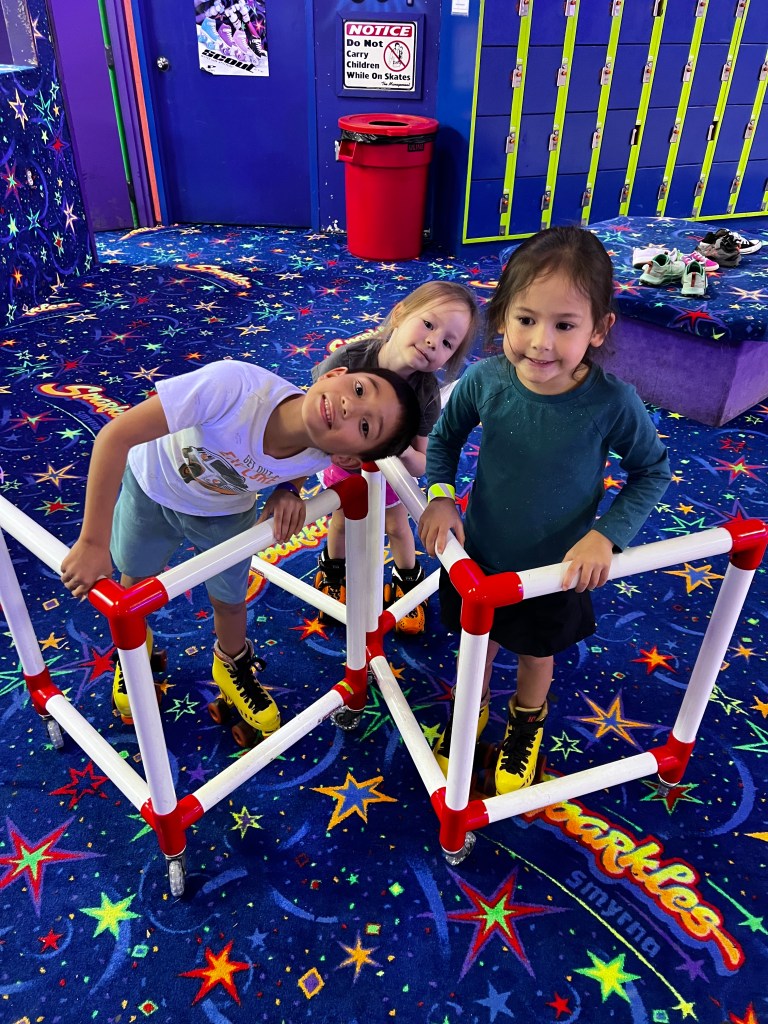


We took the kids to Sparkles Family Fun Center in Smyrna, GA to learn to roller skate. There are a handful of skating rinks around Atlanta, this just happens to be the closest for us.
Quick review: The playdates need to be a something new that the kids have never done before. Roller skating is a more-involved playdate activity and has a combination of motor skills, sensory integration, and body planning and awareness.
To set the scene, we met at the rink around 1pm. There was already a birthday party going, as well as all-ages skate ($17 admission). The rink does have Tot Skate for little kids, but it’s on Fridays during the school day.
Initially, the girls were enamored with roller skating, mostly because they’d see these pretty, glittery skates and immediately wanted them. A however was skeptical; why would anyone want to strap wheels to their shoes?
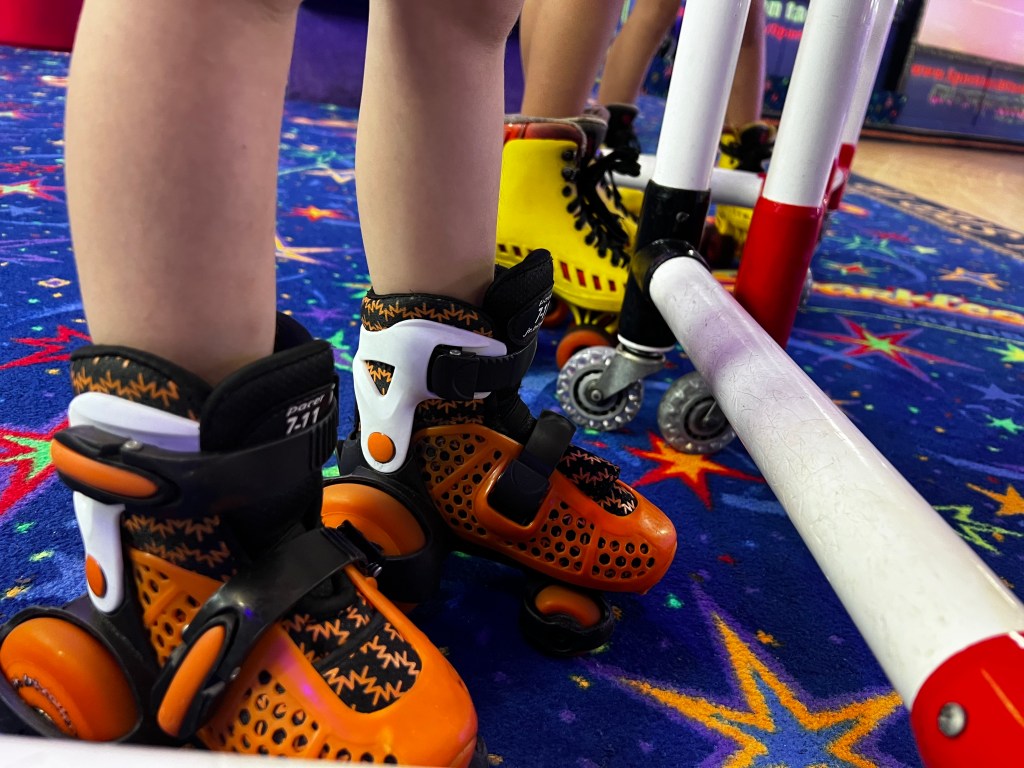
Sparkles also had an indoor playground and party area, as well as arcade games, tokens, prizes, the works. On top of the skate music and day glow, it was a full sensory dog pile. We all got our rental skates ($6 each), plus I got three skate buddies for the kids ($5 each). Skate buddies are walkers made of PVC with skate wheels on the bottom, so that kids can hold on to something while learning how to skate (pictured above).
The floor had three concentric ovals. The innermost for kids with helpers learning how to skate, the middle for slower skaters, and the outside loop for fast skaters doing tricks (oh yeah…).
I appreciated that these measures were put in place so that all skaters could feel comfortable. I also think it helped the kids to see that there were other kids learning how to skate. Lots of kids were taking spills, so ours didn’t feel intimidated or out of their element.
It took a solid hour for all three kids to gain the confidence to skate on their own. Was it perfect? Definitely not. But it started out with frustration and falls, and ended with the kids willing to get out on the rink on their own; mostly with a skate buddy, but once or twice without. I debated whether or not to bring elbow and kneepads for this outing, but decided not to. In hindsight, they probably would’ve prevented a tantrum or two.
This was another playdate where peer pressure helped. Since there were only two parents, we could only help two kids at a time and one kid would have a turn to figure it out solo. Mary and I would rotate between the kids to help with their posture or body control, or even just skate behind them with the skate buddy so they could hold on for the ride. Every 10-15 minutes, they would get to the sidewall to rest. (FYI: Did you know skating burns 1,200 calories an hour??? We worked up a serious sweat.) We thought they would give up in the first 20 minutes, but they kept deciding to get back at it and tackle the activity.
The OT Part
If there was ever an activity that could test your child’s resilience, this would be it. Trying to stand, let alone maneuvering, can be tricky with wheels under your feet. Falls will happen again and again and again. Although it may be easy for your kids to call it quits once they hit the ground, they still have to find a way to get back up and sit in a chair to take them off. Incidentally, there was a lot of frustrated crawling.
Roller skating is much like riding a bike. It’s frustrating to figure out how to balance and then coordinate movement without falling down. But once they do, it can be an immense amount of fun.
Roller skating can help:
Build a growth mindset. Kids aren’t going to put on skates and instantly become Roller Derby material. They will fall and get frustrated. Keep it positive with words of encouragement (Oops! It’s okay. You got this.) and let them know you’re there for whatever they need physically or emotionally. If you see slight progress, let them know and applaud them when they succeed.
Challenge their balance and coordination. Roller skating is like learning how to walk all over again. They know what they want to do, they just look like baby giraffes. They need to activate their core muscles to be in an upright position and then figure out how to move their body and shift their weight to skate. That takes body awareness, postural control, and motor planning. I told Z that her legs needed to be strong like tree trunks, not floppy like spaghetti.
Feed their sensory systems. Once mastered, skating around the rink can provide vestibular (movement) and proprioceptive (body awareness) input to regulate your child’s arousal levels. It can be a relaxing activity as the action is repetitive going in the same direction (left turns) or it can be thrilling as they challenge themselves to weave through the crowds as fast as they can. There’s music, wind from skating fast; all good things.
Gain confidence. Once your child figures out how to skate, they will be more apt to challenge their newfound skill set. They’ll experiment with speed, but also mimic people’s ways of skating different ways to skate (opening/closing legs, crossing one foot in front of the other, spinning/twirling, etc.)
Be social. Although skating can be a solo activity, you’re never really alone at a skate rink. There are peers who may also be learning how to skate, as well as teens and adults getting their groove on. Falling isn’t fun, but if your kid observes other kids taking spills too, they might see this as an opportunity to connect and make new friends.
Things to keep in mind:
- Get the Skate Buddy. These walkers on wheels can be helpful in building your child’s confidence, providing the physical support and a feeling of safety when first learning to skate. Just beware that the facility may collect ones that “look” abandoned.
- If your child is struggling (even with the skate buddy), work on their balance. Have them stand on a physical marker (for us, it was a star) and not move for 10 seconds. It sounds easy, but it can be tricky with wheels on. Once mastered, you can increase the difficulty having them place their arms/hands in different positions while standing (arms over head, arms crossed, hands on knees, etc).
- If your kiddo can skate but doesn’t want to part with their skate buddy, have them balance without it for 10 seconds. While they do that, move the skate buddy away from them. Once 10 seconds have elapsed, have them skate to get their buddy. Increase the distance each time they are successful. This is much easier if you yourself can skate backwards…
- Roller skating is hard work and your kids can tire easily. That doesn’t mean they are all done. Let them take a breather while you take a couple laps on the rink yourself.
The Parent Part
It is worth noting that this playdate wasn’t as smooth as our past outings. Firstly, I was severely dysregulated. We had a soccer game beforehand, and that was a bit of a struggle. I also knew the girls were going to want to do the playground and arcade, and that was not part of my plan for the day. I could smell the tantrum coming before we even left the house. Perhaps a playdate is not the best time to lay down a firm No, but it’s a hard lesson.
I don’t remember how I learned to roller skate. I just remember the Fisher-Price chunky skates that strapped to your shoes, and how much better it was to get my own pretty skates and go to skate parties in 4th grade. I was never taught to skate, so teaching my kids to skate was much harder than I initially thought. “Just go do it” definitely did not work for this age group.
There was a lot of “I don’t think skating is for me” during this tutorial, but I didn’t want the kids to give up so easily. I was very surprised and happy that they were able to rally after a short break. I think the skating gave them a bigger workout than that morning’s soccer game.
Verdict: Recommended after a certain age.
I think a younger kid needs to be coachable for this type of activity. I brought the girls ice skating when they were 3-years-old and it was very hard to explain to them what to do because they were not in a good place to listen and did not have a lot of body awareness, even with a Skate Buddy on ice. While roller skating is significantly easier and has a softer landing when you fall, explaining about posture and muscle control in a loud environment isn’t my favorite.
All things considered, a skating rink is old-school fun and a kid is never going to forget that kind of experience. If you can get over the learning hump, roller skating is an awesome activity and a skill for life.
Catch more photos and video of our trip to the roller rink on Instagram @childish_advice.
Check out our other Playdate Reviews.
Like this post? Follow Child(ish) Advice on Facebook, Pinterest, Instagram, and TikTok.
 Child(ish) Advice
2 thoughts on “Our Skate Rink Review”