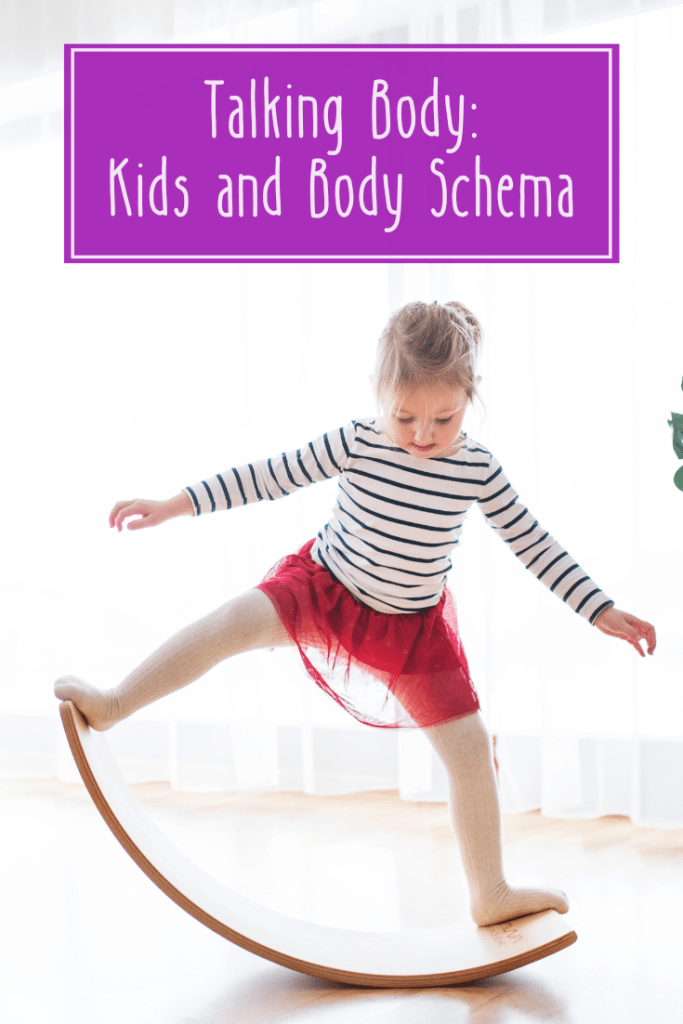
Talking Body: Kids and Body Schema

Kids have an enormous amount to learn, but before they can take on reading, writing, math, social skills, or even coordinated movement, they need a basic sense of themselves.

As children develop, it takes years for them to truly understand themselves—the “me I feel inside,” the “me others see,” and the “me I’m becoming.” That long process begins much earlier than most people realize. It starts when the brain first learns the physical boundaries of the body.

Those early signals (movement, balance, joint and muscle feedback, and deep pressure) are the “me sensations.” They give the brain its first clues about where the body begins and ends. Over time, these sensations fill in the brain’s internal “map of me,” the foundation for later self‑awareness, confidence, and coordinated movement.

Continue reading
Swooping, Sloping Cursive Letters

If handwriting is the foundation of written expression, cursive is the next layer of fluency. After children learn to shape letters and build the motor patterns of print, cursive offers a new pathway that emphasizes flow, rhythm, and efficiency.

Despite its disappearance from US school curriculum at the start of the 2000s, cursive is making a real comeback in many parts of the United States. This return revisits the question: Is cursive important?

Continue reading

Course Notes: The Cerebellum

We have talked an awful lot about the prefrontal cortex and its significance to our performance in everyday life. But what about the back of the brain, like the cerebellum? Where’s the love for that neural region? Turns out that “little brain” found at the base of the skull right above the nape of neck deserves so much applause for what it does.

The cerebellum was the topic of my latest CEU course, so this post is going to get a little technical. But trust us, it’s worth the read.

For centuries, it’s been believed that the cerebellum was only responsible for unconscious motor movement, like balance and reflexes. Although that is true, it’s not its only job. Researchers are finding out more and more about how important and involved the cerebellum really is to our day-to-day operations and what happens when it goes awry.

With its Latin name meaning “little brain”, the cerebellum makes up 10% of the brain’s volume. However, it carries about more than 50% of all the neurons (nerve cells) in our entire body. With the more neural connections than any other part of the brain, the name doesn’t seem as fitting as it once did.

Continue reading

Sensory Systems Assemble!: Sensory Processing and Integration

Photo Credit: Marvel

We’re all familiar with the Marvel Cinematic Universe and the Avengers, right? An ensemble of superheroes coming together to stop formidable foes who threaten our world. Well, our sensory systems operate in the same way.

Each sense has their own set of responsibilities but will team up with one another to understand what’s going on around us and how to appropriately respond. This collab is known as sensory integration.

Sensory integration (SI for short, also known as sensory processing) refers to the processing, integration, and organization of sensory information from our body and the environment. This process allows us to participate in day-to-day functions, from self-care to socializing.

Continue reading

Motor Planning: Animal Dice

To find this week’s Motor Planning activity, in addition to the activities in Growing an In-Sync Child, I also browsed activities on Pinterest.

Lots of themed yoga, obstacle courses; things designed to get your kid’s body into different shapes. But what to pick when it seems like your kid’s attention span is particularly short?

Continue reading