
It’s now October and we usually try to work in our fun, tongue-in-cheek tone throughout for Halloween. The book I picked out for today was an Advance Reader I got from NetGalley (again, tragically late for a review), and as Mary and I started talking about it, it became a little…scary.
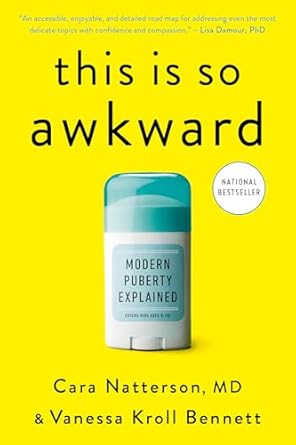
This Is So Awkward: Modern Puberty Explained by Cara Natterson MD and Vanessa Kroll Bennett.
Here’s the blurb: Almost everything about puberty has changed since today’s adults went through it. It starts, on average, two years earlier and stretches through high school . . . and for some, beyond. Gens Z and Alpha are also contending with a whole host of thorny issues that parents didn’t experience in their own youth but nonetheless need to understand: everything from social media and easy-access pornography to gender identities and new or newly-potent drugs. Talking about any of this is like puberty itself: Awkward! But it’s also critical for the health, happiness, and safety of today’s kids.
This book is extremely helpful. Period.
Each chapter addresses the health and research updates on a specific adolescence topic from the last 30 years, the changes in social understanding on that topic, and includes snippets from young Gen Zers who have just gotten out of the puberty stage. You are equipped with how to talk about that topic and how to support your kid going through it.
Why did we pick a puberty book when our kids are only 7 and 8?
Because no matter the gender, the age range in which kids are entering their adolescence is starting earlier and ending later (Extended Adolescence). A suggested review of the book recommended that parents of kids 8-12 will get a lot of solid information in the first half of the book, while parents of kids 13-19 will benefit from the latter half. The book gradually organizes content by age, starting from breasts and penises, to acne, growth spurts, brain development and mental health, sex and sexual health, gender identity, and relationships.
Here are my takeaways:
Puberty is no longer JUST about sexual maturity.
When I was just starting high school, I didn’t really get “the talk” from either of my parents. I just had to stumble through getting my period, bra shopping, and I pretty much based all of my decisions relative to what my friends with cooler parents were doing. I didn’t even have one of those It’s a Girl Thing books to have some sort of reference. My older step-sister was amazing in at least helping me feel like I wasn’t completely alone in figuring it out.
The book explains early on that modern puberty is not just the sexual/reproductive systems coming in. The entire decade-long transition is fueled by hormones and brain development, defined by social, emotional, physical, and mental growth. So just because a kid is entering the first stages of puberty does NOT mean they are anywhere near sexual maturity.
According to the book, the first sign of puberty isn’t breast buds or body odor; it’s a slammed door. Mood swings, the need for privacy, wanting to be with peers over family. Sound familiar?
Treat them according to their actual age.
Just because your kid might look older than they are, does not mean you should treat them as such. I think this is especially true for girls. Precocious puberty is when the beginning stages of puberty start appearing earlier than the average age range. So, you might have a 10- or 11-year-old who hits an early growth spurt or starts developing breasts. While this girl might look 2-3 years older, behaviorally an 11-year-old might still play with dolls, or jump around the playground, or watch cartoons.
This goes for their intellectual level as well. While your kid might look older, they might not be mature enough to handle frank conversations or content. They might not yet be responsible enough to handle social media or discern what content they are consuming. Their executive function has not yet kicked in, so they might still need a set bedtime routine or reminders to do their homework.
Even looking at some of the wardrobe aimed for tween girls, you can tell there is a bit of a push to look older. Nevertheless, use your best judgement and parent the child you have.
Awkward Conversations
The more often you can talk about adolescence and puberty, the better. Instead of trying to have one big overwhelming and weird talk about sex and changing bodies and relationships, the authors suggest having small, frequent conversations as they arise. This takes the pressure off both you and your kid, and it helps build trust so that your child will feel more comfortable having these talks with you.
The authors encourage active listening; don’t try to make it a conversation about how you were growing up. They also suggest leading with the science foot. Use technical, appropriate language to explain what is happening in the brain and body, apart from personal experiences and judgement.
It is important to make the discussion kid-led. Let them raise the question and explain their take before you jump in. If you have a question for them, raise it as a question instead of a negative judgement. The authors also recommended having talks in the car since no has direct eye contact with each other, making it less awkward.
Some non-sexual topics might even lead to a more engaging talk about the sex and gender landscape that has nothing to do with their body personally. Think about if your kid has questions about Roe vs. Wade, consent and personal space, random song lyrics, Pride Week, etc.
Period.
I got my period just before my 12th birthday. This was still on the early end compared to the rest of my friend group. Imagine my surprise in high school when a girl I was babysitting said she had just gotten her period at 9. I felt so bad. All the stress I was having about avoiding accidents, or always having period products with me, or managing cramps; I couldn’t imagine her having to do it in third grade.
Yes, I think we all have read that young girls are getting their periods earlier and that hormones in milk or ultraprocessed food is the culprit. However, according to the book, while ages of beginning puberty on average have shifted forward, the average age of first period for girls has stayed squarely at 12.
We know that the age of first period is influenced by ethnicity and background, with Black and Hispanic girls showing earlier. We know that it is also somewhat genetic. If your mother/aunts had earlier or later periods, chances are your body would follow suit. This serves as a good opportunity to anticipate when the first period will happen, and how to listen to your bodily cues when it does.
Good news. Gen Z socially has been able to dispel a lot of period stigma, very much normalizing it to where girls should not have so much stress about getting their periods in school environments. The rise of new period products as well (menstrual discs, cups, period underwear) also gives people with uteruses more options that aren’t so uncomfortable.
As a side note, every chapter includes trends and new products that the current generation of teens are using to give an updated baseline of what is “normal”; ranging from shaving or not shaving, to not wearing bras, to clean makeup and birth control options.
The book goes into so many more topics, all beginning with new research, dispelling old ideas, and then giving a much more empathetic view of what tweens and teens are going through right now. I thought the chapters on hygiene were really helpful, versus coming from a “you smell bad” point of view. The chapter on birth control was much more clear and explanatory for both genders. And the chapters on sleep, brain development, and mental health are a great primer for parents who are worried about entering the puberty years. Think of it as Inside Out for the teen brain.
The later chapters on sexual orientation, relationships and gender identity are very open and information-driven. Even though many parents may not need to broach topics like puberty blockers, the book gives parents more of a framework to understand the topic and what options kids have in today’s medical and social landscape.
Overall, I love how informative the book is. Even though my kids are only in second grade, I feel much more confident about eventually having these discussions. I think there is a lot to be scared about (most recently about AI and building kids digital literacy), but I think I can give my kids a much better experience that is much more information-based than what I was given.

Browse here for more Child(ish) Reads.
Like this post? Follow Child(ish) Advice on Facebook, Pinterest, Instagram, and TikTok.

