
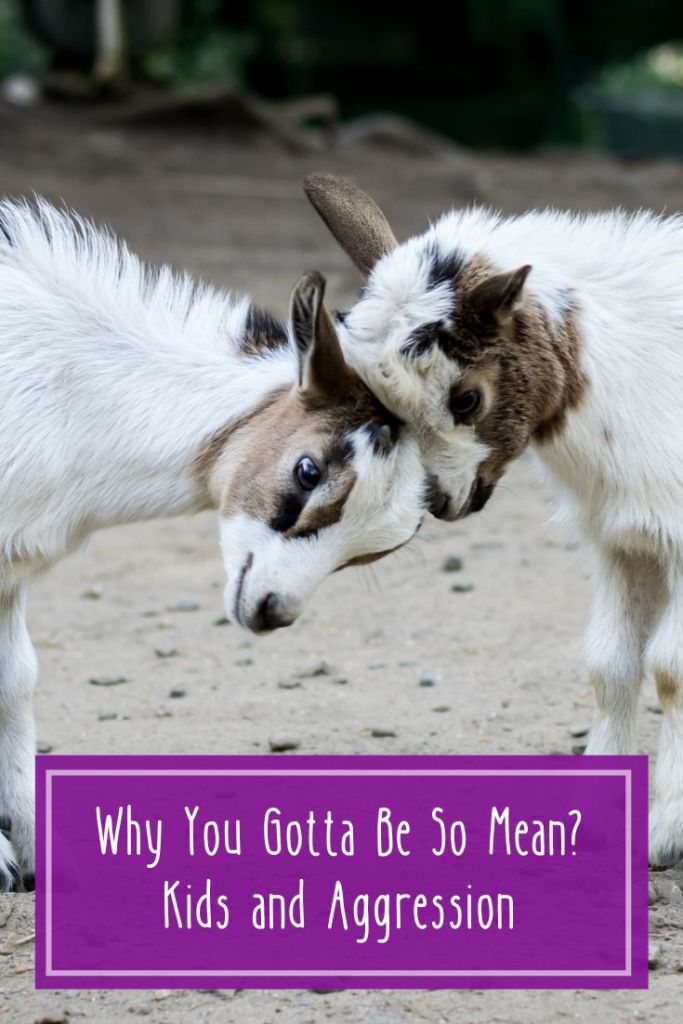
From rough housing to name calling and everything in between, children showcase a spectrum of aggression. While it may be for fun, it can be downright vicious in certain circumstances. Babies start showing these behaviors around 8-12 months of age to express their frustrations; but it starts to diminish when they learn appropriate means to express and acquire their wants/needs. However, school-aged children can take it to another level.
Kids demonstrate aggression in various ways:
- Physical – some form of physical force towards someone (hitting, biting, kicking, hair-pulling)
- Verbal – words that are meant to hurt someone’s feelings (yelling, name calling, threats)
- Relational – actions intended to outcast someone (excluding, spreading rumors, manipulating friendships)
All of this hostility can be traced back to anger. While anger is a natural emotion, aggression is the resulting behavior.
Anger Issues
Much like fear, anger is a response to perceived threats or stressors in the environment (it’s the “fight” in the flight-fight-fright response). And much like fear, it is a quantitative emotion. This means that any excess of a stressor can ultimately trigger an anger response. Understanding a toddler’s actions is usually straightforward, but deciphering the reasoning behind older kids’ behavior can be more challenging. So what spins aggressive behavior?
Anger starts at the amygdala, the part of the brain responsible for emotions and arousal level. When a threat occurs, it sounds the alarm to prep the body for battle. However, the prefrontal cortex steps in to help temper the emotional response at the slightest provocation, preventing any immediate, impulsive regrettable action to take place. Because our kids are learning self-control and self-regulation strategies when something angers them, it usually ends there…sort of. The neurochemicals in our brain can play a role in how aggression manifests. For example, cortisol (the stress hormone) influences the intensity of anger while dopamine (the feel-good hormone) can fuel the desire for rage and revenge when wronged. If that’s the case, what’s with violent play?
All Fun and Games
Playful aggression is a form of consented social play that involves rough and tumble play, pretend fights, and adrenaline-fueled chase scenes with no intention of harming one another. Although it starts in the toddler years, it’s common among elementary school boys. Violence and aggression are embedded in our culture and in many forms of entertainment. For example, researchers point out that “good guy” superheroes are often more brutal than the “bad guys” they defeat. Additionally, many toys, tv shows, and games containing this type of brutality are marketed towards boys.
Boys tend to participate in this type of play more often and with greater energy than girls. Due to evolutionary brain wiring and testosterone, relationship hierarchies play a role in males’ social and emotional development. This means that playful aggression in boys is more hierarchical, active, and intense than their female counterparts.
From a developmental perspective, this form of play serves an important function by helping kids learn to manage, contain, and control their aggressive impulses. Aggressive play allows children to explore and work through these feelings without hurting anyone, reducing the need to act out these behaviors in real life. It also challenges their physical strength and fulfills the desire to feel powerful, as seen when playing heroes and villains. You can also see this when people take karate, wrestling or kickboxing classes. This form of play can also help them figure out real-world scenarios, gaining mastery over any confusion or fear they’re experiencing.
It’s also important to mention that the way a child views guns or death in their games are not identical to ours. Kids typically don’t understand these concepts until 6 to 9 years of age.
A Simple Misunderstanding
Just because rough play is part of a kid’s typical development doesn’t make it any less unsettling to deal with. This may be because some adults (such as myself) can’t tell the difference between aggressive play and actual fighting, and research backs this up.
A study using video recordings of boys engaged in real or play fights revealed that children aged 8 and 11 could accurately identify the type of fighting approximately 85% of the time. Adult men correctly classified 70% of the scenes as well as adult women who grew up with brothers were as accurate as the men. However, women who grew up without brothers predominantly perceived all the videos as real fighting. Hi, I’m those women.
So, how can you tell the difference between the two? In rough play, kids are:
- Smiling and having a good time
- Taking turning attacking each other and are mindful not hurt each other
- Willing participants and ready to engage in some form of graded physical contact
- Going to play with each other after that form of play is done
Even though it can be intense and many a times we’d like to stop it, research shows that play-fighting turns real only 1% of the time among elementary school boys.
“Love you! Mean it!”…Not…
For boys, rough play often means fun with friends, but the same cannot be said for girls. Boys are more known to directly engage in physical and verbal forms of aggression. Girls, on the other hand, express it in a more indirect manner. I mean, they made a whole movie about it (thanks Tina Fey).
Compared to boys, girls are inherently social beings. They exhibit greater emotional awareness and place a higher value on forming connections with others. Neuroscientists suggest the reason is because the female brain is not exposed to high levels of testosterone in the womb. This means that girls are born with a better ability to read faces, hear vocal tones, and empathize with others. Additionally, studies have shown that infants and toddlers with lower fetal testosterone levels exhibit higher eye contact, better communication skills, and larger vocabularies. While some boys do possess these skills, it is generally girls who are naturally equipped to connect with those around them from birth.
Because of this social wiring, it’s no surprise that girls are more likely to engage in relational aggression out of all the others. Sticks and stones may break bones, but words can leave some nasty emotional wounds. What makes this aggression more vicious than others is that this behavior and underlying anger are often concealed, presented in a manner that appears harmless and easily dismissed. This covert antagonism deprives the victim of any opportunity to counter the accusations, and any attempts to defend oneself typically result in further escalation of the situation.
Relational aggression is very much like psych warfare. While it emerges in children around 3 years of age, it’s more sophisticated and covert forms appear during the elementary school years. So if girls want to hurt someone, they do so by disrupting any measure of social harmony. These “mean girl” behaviors manipulate and damage relationships with the intention to crush one’s self-esteem or dismantle their social status in a peer group.
While this form of aggression is often associated with females, research indicates that boys exhibit it at similar levels. However, girls experience greater psychological suffering when subjected to this type of aggression. Even when boys and girls are exposed to the same levels of social aggression, girls find it more distressing and hurtful because of its social and emotional impact on their life.
Lessening the Blows
Aggression is inevitable with kids, no matter how they show it. It then becomes our job to help them navigate their feelings to help them handle these hostile situations with peers.
- During playful aggression, monitor and offer guidance when it gets too intense.
- Become a safe space for your child to talk about anything, from their feelings of anger to challenging social situations at school. Watch for changes in behavior so problems can be caught early.
- If your kid was being mean, help them dissect why. Guide them in understanding why the behavior was wrong and how it was hurtful. The apology isn’t as important as figuring out more appropriate ways to respond to distressing situations.
- That being said, normalize apologizing, taking accountability, and “squashing the beef”
- Watch your own anger and aggression. Kids observe how we deal with people who stress us out and will incorporate those behaviors.
Like this post? Follow Child(ish) Advice on Facebook, Pinterest, Instagram, and TikTok.
Sources:
Boys: Understanding rough and tumble play | First Five Years
Do Boys Need Rough and Tumble Play? | Psychology Today
Bringing up girls: Biology and behaviour | First Five Years
Brain Chemistry and Anger: Neurological Triggers Explained (neurolaunch.com)
Managing Aggressive Behavior in Children: Causes and Solutions (neurolaunch.com)
 Child(ish) Advice
2 thoughts on “Why You Gotta Be So Mean?: Kids and Aggression”