Playdate Behavior

Based on our Playdate Reviews, you know that Mary and I have been doing bi-monthly playdates with our kids for over a year now since they’ve been in the school-age stage. But for the last couple big playdates, I started seeing some patterns.

I feel like what we are seeing is probably similar behavior to what you’ve seen when kids are in groups: talking over each other, getting louder in volume, fighting for attention and showing off, getting jealous, making rash decisions, and going apesh*t when the playdate ends.

At the end of these playdates, I’ve felt like I had to incessantly apologize and abort mission on more than occasion. Baby and toddler playdates are going to have a different vibe, obviously. We are far from the time when we could’ve just hung out with wine while the kids did whatever.

That is not to say that all playdates are like this. I look forward to picking and planning these outings and our kids very much see each other as best friends. So let’s talk about the ups and downs of playdate behavior and what Mary and I have done to stay cool.

Continue reading
Coffee Chat: Challenging Behavior at School

I thought it relevant and a natural extension to the big, baffling behavior conversation to talk about our kid’s behavior at school. While our kids are at school, they are 100% out of our control and that can be nerve-wracking.

I would be mortified if our kids acted at school the way they act at home. Not to say that their behavior is particularly bad or challenging; they are fairly typical but today’s breakfast outburst was super annoying. I think we all have a fear that our kid is going to cry/scream/throw themselves on the floor on the daily when we’re not there.

We’ve also been told that bad behavior at home is age-appropriate. It means that your kid is comfortable enough to lose their sh*t with you. But a kid who misbehaves at school means that the kid is in fight/fright/flight mode with parents and this is indicative of problems at home. The reverse psychology of it has us feeling like any hiccup is a direct sign of bad parenting.

So what do we do and what role does the school environment and teacher play?

Continue reading

Child(ish) Reads: Raising Kids with Big, Baffling Behaviors, Pt. 2

Back with Part 2 of our Raising Kids with Big, Baffling Behaviors review.

We got into what goes on in our kid’s brain when they are dysregulated and showing bad behavior. But it takes two to tango, and how we react to our kids during the tumult matters.

So here are the parent takeways that help us keep our heads:

Continue reading

Child(ish) Reads: Raising Kids with Big, Baffling Behaviors

First Child(ish) Reads review of the year!

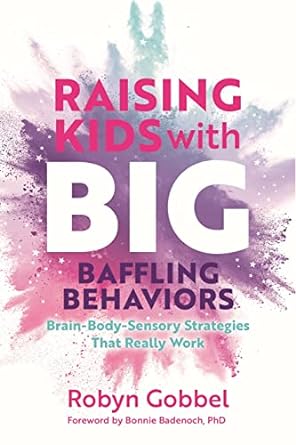
Today’s post is on Raising Kids with Big, Baffling Behaviors: Brain-Body-Sensory Strategies That Really Work by Dr. Robyn Gobbel. And of course, it has the magic word: sensory.

Dr. Gobbel is a psychologist with a Masters in Social Work, so this book is all about the neuroscience behind challenging child behavior. It had some pretty lofty goals in the Introduction: to completely change the way you parent. Challenge accepted.

Continue reading

Course Notes: Challenging Behaviors, pt. 2

For the record, not all behaviors are bad. Our kids are figuring out how to navigate their world while simultaneously learning who they are and advocating for themselves. What constitutes challenging behavior is when their actions hinder their ability to learn, complete daily tasks, or engage appropriately with others. While some behaviors occur once in a blue moon, like that total meltdown at grandma’s house, it becomes a problem when it’s consistent (aggression/defiance at grandma’s house, at the store, at school, at a party, you get the idea).

In this post, we’re getting down to the bottom of these behaviors: why they’re happening, why they continue, and how we can help our children manage and reduce them. So grab your magnifying glass Watson, because we got some investigating to do.

Continue reading