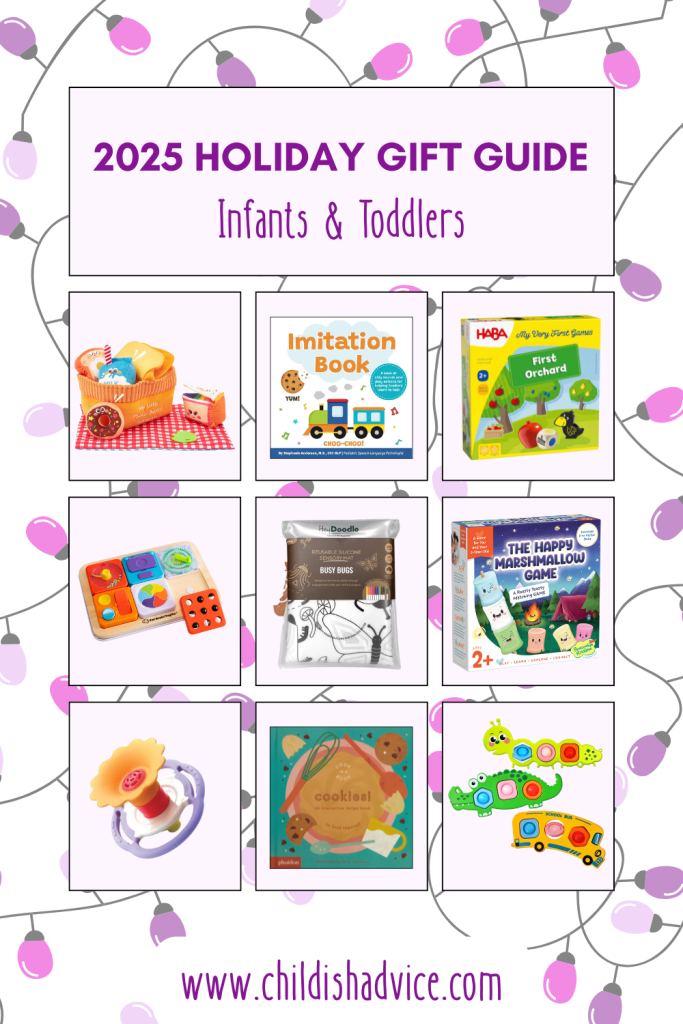
Holiday Gift Guide 2025: Infants and Toddlers

October is behind us, which means it’s officially wish list season. Sorting through the avalanche of toys and games online and in catalogs can feel more than a little overwhelming. I’ll be honest: narrowing down our favorites wasn’t easy. So yes, our list is on the larger side this year. But in our defense, every pick earned its spot.

To make the Child(ish) Advice list, we researched:

  • Is it cool and new?
  • Does it support child development?
  • Does it stand out from all the rest?
  • What do the reviews say about durability and practicality?

This year, we’ve grouped our favorites by target age and by category. First up, infants and toddlers.

Continue reading

The Girl Brain

While working at a pediatric clinic, seasoned therapists often noted that boys responded best to clear expectations and consistent consequences, while girls benefited more from patience, emotional connection, and time to process instructions and feelings.

When I was just starting out, I assumed all kids processed things the same and saw girls’ need for patience as coddling. For context, I was raised in an Asian household where emotions were seen more as a weakness than an asset. So, if you had to cry, go outside.  

With time however, I realized I was wrong. It wasn’t that they didn’t understand the task; it was that they wanted to get it right so badly. Sometimes they’d miss the mark on the first try, or they’d misread my tone and think I was upset with them. Other times, they were simply grappling with the fact that there was no room to negotiate the task or the consequence. What they needed wasn’t leniency—it was time, clarity, and emotional safety. Check out this IG video.

We know that boy and girl brains are different, but what are the actual characteristics a girl brain and makes it’s learning processes distinct from its male counterpart?  

Continue reading

The Boy Brain

Ever since my son was in daycare, I’ve heard “boys will be boys” tossed around. This was mostly to explain his energetic, impulsive behavior, especially during play or social interactions. I’ve never liked that saying. It felt like a shrug, an excuse, as if rough-and-tumble behavior is inevitable or exclusively male. And let’s be honest, girls can stir up just as much chaos as their male peers.

But as he moved into elementary school, the patterns became harder to ignore. More boys in his grade were on medication for ADHD. More boys were getting flagged for disruptive behavior. The gap wasn’t just anecdotal anymore. It was showing up in classroom dynamics, discipline charts, and parent-teacher conferences.

Recent research confirms that there are differences between male and female brains, but I keep wondering: Are those differences present before puberty? And if they are, how much do they actually shape the way boys and girls learn, connect, and navigate the world around them?

In this two-part series, we’ll explore how brain development may diverge between boys and girls, and how we can best support them as parents as they grow. First up: The boy brain.

Continue reading

Cry Baby: Baby Cries and Language Development

Babies cry. Period.

For those first few months, newborns sound the alarm every time they feel slightly off kilter. As a new parent, it can be rough trying to decipher what your baby needs. Regardless of how many parenting books you may read, decoding cries doesn’t necessarily come with textbook instructions

Crying is the first and most important form of communication infants have with their parents and caregivers. Their entire survival depends on it. The first two months of life, their cries intensify, peaking between 6 to 8 weeks before significantly decreasing by 3 to 4 months of age. This decline aligns with key developmental milestones, such the emergence of self-soothing behaviors (sucking fingers to turning head away when overstimulated), vocalizations (cooing and babbling), and motor skills (reaching, grasping, pushing up onto elbows and forearms during tummy time).

Although it can be tough to handle your baby’s cries, especially in the moment, there’s always a rhyme and reason behind them. Every cry is a way of communicating a need.

Continue reading

Child(ish) Reads: Raising A Socially Successful Child, Pt. II

When we say “socially successful”, we mean making friends. Yes, how our child conducts themselves in public spaces in a way that is socially acceptable is one thing. Manners and etiquette are explicitly taught.

However, making friends is not exactly easy for most. Confidence, self-esteem, temperament; these all factor into the process personally. But then there is the reciprocation, the two-way street. Does this person like me back?

In Raising a Socially Successful Child, Dr. Stephen Nowicki explains the Friendship process; the different stages of how we start and maintain relationships.

Continue reading