
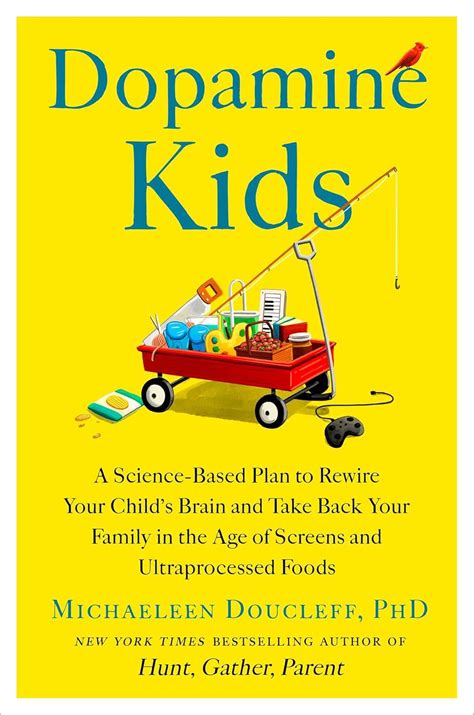
I was very excited to receive my pre-ordered audiobook of Dopamine Kids by Michaeleen Doucleff. Yes, the same Michaeleen Doucleff from Hunt, Gather, Parent. It has been 5 years since I reviewed that book, and I love how Dopamine Kids fits in so perfectly with all of our Brain-Body posts this month.
Dopamine Kids: A Science-Based Plan to Rewire Your Child’s Brain and Take Back Your Family in the Age of Screens and Ultraprocessed Foods by Michaeleen Doucleff.
Blurb: For the first time in history, we are inundated with “dopamine surges” inside our brains, pulling us to technology and ultraprocessed foods like magnets—every day, many times a day. Over the past decade, neuroscientists have finally begun to figure out how these surges alter our choices, our habits, and even our moods. We’ve learned how dopamine can drive adults and kids to engage in activities that we don’t actually enjoy—activities that can make us feel sad, lonely, anxious, and depressed.
When Michaeleen Doucleff decided to address her family’s screen time and dependence on processed foods, she found that scientific study after scientific study refuted nearly all the claims in the media about dopamine and the supposed reasons why we’re so inclined to pick up our phones or raid the pantry. She took this new neuroscience and psychology and merged it with practical experience, shifting the power dynamic back to families: Instead of devices and foods controlling us, we control them, and both screens and the pantry become tools rather than burdens.
Her introduction is particularly grabbing: If our kids were truly getting joy and pleasure out of screens and ultraprocessed food, why are they so crabby/anxious/moody?
When we complete a project or go on vacation or finish a good book, we aren’t completely hostile and have a meltdown when that time is over. Those things actually give us pleasure, whereas doom scrolling and binge eating do not.
Brain Chem
Dopamine, the reward hormone, hits a little differently with screens and processed food. The book spends a good amount of time talking about how apps, shows, and notifications drive us to developing addiction the exact same way that that gambling does. So instead of looking to your phone as a portal for learning or staying connected, it functions more like a slot machine. Doom scrolling is the equivalent to pulling the lever and losing your quarter, over and over and over again until you don’t know what day it is.
When you think about how kids consume their screen time, think about how easy it is to binge a show. The next show follows right up as soon as you’re done with an episode. The next YouTube video is in queue. Minecraft and Fortnite are revolving doors, bringing in new players at any time of day. If they didn’t have a time limit, there would be no reason to get offline. Even going to the bathroom or mealtimes don’t serve as adequate flags to power down anymore, if they even feel those flags at all.
The same goes for eating ultraprocessed food. If you have a bowl of chips in front of you, even if you are already satiated with one or two chips, chances are you will probably mindlessly eat until the bowl is empty. If you have a super sweet dessert, the first bite might taste great but the satisfaction of eating it will probably wane after the third bite. Yet, we will still eat it until its gone.
If this sounds like an awful lot of diet culture talking, it is. Eating food and enjoying flavor are pleasurable and it gives our brain a lot of dopamine. As much as adults know we have to reel it, kids’ brains don’t have that control. So just like all of our childish advice, you have to be your kid’s brain for now.
The Five-Step, Four-Week Transformation Plan
What’s different about this book, compared to Hunt Gather Parent, is that Doucleff gives us an actual transformation plan; which at the beginning is a very tall order. You are essentially trying to replace bad screen time and eating habits with ones dubbed “high-value activities”. There are PDF resources for you to follow along and implement your own plans at home. Being super enthusiastic, I’m going to implement my plan with A&Z this spring. I will go over those details for Thursday’s post. Yep, you got a two-parter.
What do you know, the first part of the plan is to outline your family’s priorities. If Michaeleen Doucleff and Emily Oster ever did a tour, I would be the first fangirl in line. These five steps weaken the neurological pathways established by devices and make dopamine work in your favor to get kids to want to pursue high-quality activities that reduce anxiety, create better moods, and diversify interests.
Step 1: Take the Wheel – Decide on priorities for family. Create a dream list of goals and values.
Step 2: Ride the Motivational Wave – Determine high-values activities to replace shallow habits.
Step 3: Celebrate to Habituate – Reinforce the new habits with positivity and excitement. Show progress.
Step 4: Shine the Bright-Line Rule – Create clear rules around these habits and priorities (not vague).
Step 5: Curate the Cues – Get rid of bad habit cues and replace with new ones.
All of these are available on the author’s website, so I’m not giving away anything. However, the way Doucleff layers each of these rules throughout the book in a practical, applicable way makes me think this is way more do-able from the jump. It also motivates to get started right away.
Just like a diet, if you don’t take active steps to reshape your lifestyle, positive habits are never going to stick. So if we are serious in trying to course correct habits for this generation, go all in. While the book centers around eliminating screen addiction and ultra-processed foods from our homes, you could also apply the approach other things in your household. And keep in mind, this will affect your WHOLE household.
High-Value Activities
I loved how Doucleff outlined high-value activities. Yes, we all want our kids to love being outside and prefer them being active over being couch potatoes. But it’s not enough telling them to learn to deal with boredom. Specifically, she says to encourage activities that are easy to pick up by themselves, quick to see progress, and provide an overall benefit. This gives kids the dopamine but in a way that is high quality.
Kids could pick up baking, crocheting, or making models. If your kid is more into physicality, then there’s woodworking, building, gardening, etc. She even lists chopping wood as an option. These are activities that aren’t daunting tasks, but they do require kids to try, make mistakes, and learn. In the end, kids can see something tangible they’ve made/accomplished and get satisfaction from the process of doing it.
She does say that while practicing sports skills in the backyard are great, they don’t always have something actual to show for it until much later. There’s not a clear beginning and end point. This is where there is a clear delineation between a sport and a hobby/life skill. I’d also add that chores, while they provide a benefit and are quick to accomplish, they most likely don’t give us pleasure.
Doucleff gives the example of her daughter Rosie wanting to buy cookies from the store. Instead, she encourages Rosie to make cookies herself. First, making cookies from scratch eliminates the ultraprocessed ingredients from the store-bought. Second, on her own, Rosie learns to follow recipes, use the oven and other baking equipment, and has a batch of cookies to show for it. After the work, Rosie chooses to only eat one cookie and saves the rest for the family to enjoy for later; the opposite of eating an entire sleeve of cookies from the store. Over time, Rosie learned to bake more types of cookies, muffins, breads, eventually leading to making meals and other recipes. She developed a high-value skill that will serve for her whole life.
Doucleff adds that never once has she had to forcefully take away baking equipment like she had to do with an iPad. The skill brings pleasure, not an addiction.
Kill the Cues
This part hits adults a little harder than for kids. While our kids are still young, we control their access to screens and foods. If we are trying to swap screens for something better, we can hide the screens, put hard limits on time, and block sites. Once kids get older, it’s a different negotiation.
Similarly, all that work blocking their access to screens goes out the window if we are constantly on our smartphones, leading with the bad example.
Doucleff shares some of her own cues to illustrate how some of the smallest things can trigger a dopamine habit. She talks about making dinner and instantly wanting a glass of chardonnay. She shares that during a day out with Rosie, she felt the need to check her phone whenever there was a short lag of time between conversations. She would get on her phone, check email, Twitter and Facebook, and then check those three apps over again as if something new was going to pop up in the two minutes she was on another app.
Sometimes killing the cues can simply be out of sight, out of mind. Other times, we’re actively trying to go analog, bricking our social media access, and reorganizing our pantry. In addition, it’s important to put those new activities and better-for-you foods front and center.
It’s important to say upfront that the book does not condone going full Little House on the Prairie. You don’t have to completely shield your kids from screens or junk food. Doucleff acknowledges that outside of the home, her kid is going to school, birthday parties, and other kids’ houses where all this stuff will still be. She is going to get access to it regardless. However, the goal is to keep the boundaries strong at home (where kids spend the majority of their free time) in order to rebuild those habits and neural pathways. So when your kid is out in the world, they can navigate the junk without reverting back in gremlins. Similar to training a kid with a food allergy.
Same applies to screens. If we can limit access and motivation while they are young, and replace that magnet/cue/trigger with something better, then we can rewire their brains to not be so dependent on screens when they get older. You are actively building healthy habits.
Overall, I really liked how practical this book is and it reinforces a lot of the good habits that we adults are trying to build as well. I think there is definitely a fear factor involved seeing the lack of critical thinking skills and initiative that teachers are reporting in classrooms. I believe a lot of Millennial parents are trying to “go back to the old days” especially when it comes to screens and junk food, in favor of more time outside and eating a more well-rounded diet. Hopefully, this ripple effect will result in our kids being better students and people.
I’ve obviously hit my word limit and still have more to talk about for Thursday’s post. Check out the book and I hope you enjoy it!
Browse here for more Child(ish) Reads.
Like this post? Follow Child(ish) Advice on Facebook, Pinterest, Instagram, and TikTok.
 Child(ish) Advice