
When I was in college, our rowing team competed at The Head of the Charles in Boston, and a group of us stayed in one of the dorms at Harvard. The girl we stayed with was a friend of some of our rowers and she had a twin brother who also attended Harvard.
So, there’s two high-achieving kids in the same family who are Harvard educated. I found out later that they had triplet younger sisters, all of which excelled in their own respective sports, including rowing and wakeboarding. Later, all five of the siblings would graduate and enter the fields of medicine and public speaking. How? Just… how??
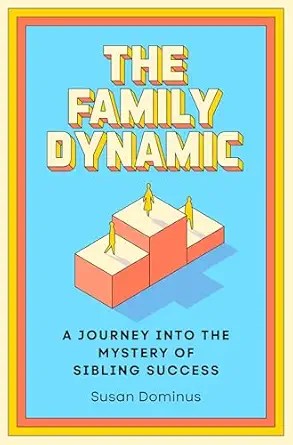
The Family Dynamic: A Journey into the Mystery of Sibling Success by Susan Dominus.
Burb: An Olympic athlete. An award-winning novelist. A successful entrepreneur. All raised under one roof. What can we learn from those families whose children aim high and succeed, sometimes in widely varied fields? Just as important: What were the costs along the way, and what can we glean from their travails and triumphs?
The acclaimed New York Times journalist Susan Dominus offers compelling profiles of six such families in search of the factors that led to their success—was it an inherited quality, a specific way of parenting, the influence of a sibling, or a twist of luck? Inspired by the iconic Brontë sisters, whose remarkable literary success prompted endless speculation, Dominus, the mother of twin teenagers, sought out contemporary high-achieving families who shared intimate stories of their upbringing. She introduces us to the Chens, young parents who fled their country’s one-child policy to open a Chinese restaurant in Appalachia—then sent four children to elite colleges and on to careers that give back in technology and medicine; the Groffs, whose claim to fame is not just an award-winning novelist but an Olympic athlete and a notable entrepreneur; the Wojcickis, whose daughters made inroads as STEM pioneers in Silicon Valley; and the Murguias, who rose from exceptionally humble origins to become powerful jurists and civil rights champions. Woven into these and other stories is an account of centuries of scientific research into the ongoing question of nature versus nurture.
I was so excited about this book that I read it last August when it became available at my library. Now that it’s six months later, I still wholly recommend this book but I have no notes or quotes to share. So, this book review is going on the lasting lessons.
What I liked about this book was that these families were so different but so completely human. Hearing stories of these parents and their remarkable children show that it is not a one-size-fits-all formula for raising high-achieving kids. It’s the home you create for your family. It’s the experiences you expose them to. It’s the relationship siblings cultivate with you and with each other. It’s the connection between themselves and their community.
Those factors altogether seem so easy, but they are so hard to implement without the necessary nuance and care. So, here are the common threads I found while listening to this book.
Enterprise Parenting
Ambition is a given. It seems wrong to start off with the parents when the real stars of this book are their kids. The parents in the featured families are very clear that they want their kids to happy, but they impress that their kids have the agency and drive to become great. Some of the parents sacrifice a great amount to set their kids up for success. Some set the bar high by modeling work ethic or curiosity or resilience. I did notice that the parents all had something else going on in their lives besides child-rearing. They all had their own personal hobbies/jobs, past histories, or work in the community. This exposes their kids to how big the world really is.
In a podcast with the author, she says that in some cases parents create the plan for their child, and their kid follows through. While this may seem a little strict and definitely subject to change as their kids get older, the parents start out from the beginning with structure for achievement. That might be through musical instruction, academic and athletic achievement, or going into specialized programs or schools at a young age. This can be daunting, but it establishes that they have the belief that their kids can achieve something great.
There is a bit of Tiger Parenting, but it is not throughout.
Friendly Rivalry
We are all familiar with the concept of sibling rivalry, but in these families, there is an overwhelming power of sibling synergy. Sometimes that is helping each other academically or helping younger siblings navigate college or their professional fields. Other times it’s wanting to be so different from your siblings that it pushes you into a completely different sport or wanting to compete with your sibling so much that it pushes you to work harder.
This friendly competition shows that these sibling relationships are not all sunshine and rainbows. No one is expecting the Brady Bunch, and siblings do not have to have that type of relationship to be successful. In this case, you can see how that ambition and belief of capability implemented by parents is supported and reaffirmed by the brothers and sisters. The shared experience that you and your siblings are going through together serves as your port in the storm, and something that you can pull strength from.
Genuine Love
It is very clear while reading this book that none of these high-achieving people just wanted to get rich. There is a theme throughout of these siblings wanting to do well by their communities. They are active politically. They represent and give back to the people who supported them. They use their gifts to bring something new or needed to their hometowns. As they grew up, it’s not just their parents pushing them into the world. They learn and see themselves as part of it. Their ambition is supported by the love of their community.
The parents also do a great job of “creating the village”, whether that is through trusted professional connections, seeking out instructors or coaches, or finding references in the community.
Self-Reliance
It’s us against the world. In every other chapter, Dominus contrasts her research with the Brontës. Sisters Charlotte, Emily and Anne all became published authors in the 19th Century. While their father tried to place the familial responsibility to their brother Branwell, it was clear he wasn’t as driven. The book alludes that this pushed Charlotte and Emily to pursue their dreams of writing, knowing that they had to rely on themselves. Then Anne effectively said, “We’ll if you’re going to be a writer, watch me do that, too.”
As with the families highlighted in the book, there was very much an intentional lack of safety net. The siblings were raised to rely on themselves to get things done. While the parents would support their kids’ endeavors and sometimes push them to think bigger, there was never the feeling of resting on your laurels. The kids are the ones making it happen.
In some families, the parents or single parent works above and beyond in their jobs. A couple of the featured families do have immigrant parents, or parents who previously worked and lived abroad. As a result, the kids have personal responsibilities at home and for own self-care. This does give a bit “fend for yourself” but also makes the kids work as a team, keep to a routine, and look for each other especially at school.
The book has chapters on nature vs. nurture, twin studies, birth order, the Big Five personality traits, etc. These are spliced in between the profiles of each family and give the much-needed longitudinal research to balance out the personal stories. Dominus is very clear that this is not a how-to book. In fact, I really appreciate her approach because lots of parenting books focus on a single kid in a vacuum. They don’t factor in how having multiple kids and multiple schedules influence each other.
Writing this, I would even go back for a second read through to catch a lot of the research I missed. I know that many families only have two kids, whereas in this book most of the families have at least three. This doesn’t prevent you from being able to nurture the type of dynamic related in the book. And while I think every parent wants their kids to be happy, I think it’s important to emphasize that should be happy on their own terms, through their own drive.
Parenting is such a long-game task. There are sometimes when I feel like I’m being too hard or too insistent on my girls doing things on their own. But I do see a spark of teamwork and sisterhood between them, and I hope that they are building a supportive relationship with each other.
Browse here for more Child(ish) Reads.
Like this post? Follow Child(ish) Advice on Facebook, Pinterest, Instagram, and TikTok.
 Child(ish) Advice