
In December, I usually pick a fun book to review; mostly to whiz through it and have a light-hearted post. This one changed up a bit on me.
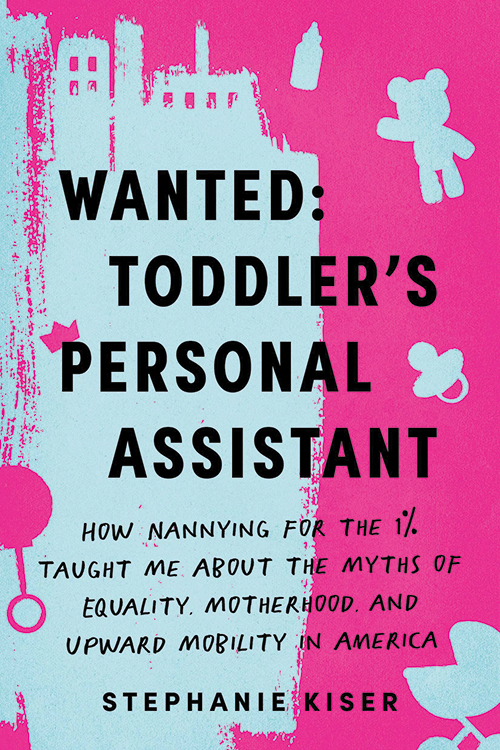
Wanted: Toddler’s Personal Assistant: How Nannying for the 1% Taught Me about the Myths of Equality, Motherhood, and Upward Mobility in America by Stephanie Kiser
Blurb: When Stephanie Kiser moves to New York City after college to pursue a career in writing, she quickly learns that her entry-level salary won’t cover the high cost of living―never mind her crushing student loan debt. But there is one in-demand job that pays more than enough to allow Stephanie to stay in the city: nannying for the 1%. Desperate to escape the poverty of her own childhood, Stephanie falls into a job that hijacks her life for the next seven years: a glorified personal assistant to toddlers on Manhattan’s Upper East Side.
Since this book is a memoir, I couldn’t decide if I wanted to focus on the secret life of nannies, how income inequality affects childhood, or if parenting in significantly higher income brackets is any easier. Even toward the end of the book, I wasn’t completely sure on where it should land.
While some parts are ridiculous (as the case with I Left My Homework in the Hamptons), I think the contrast with the author’s childhood is the starkest. Stephanie alternates each chapter between the current experiences she is having with each of her families to the past instability of her own childhood. Growing up with volatile parents and younger siblings, with no motivation to do well academically, Stephanie struggles to find a path. Her parent’s non-support is the most tragic. As she traces those effects through her time at home, being a scholarship student at a private all-girls school, into college and in her first years in NYC, you can see how she’s caught between having a chip on her shoulder towards her wealthier peers and wanting to be better than her roots.
On the flip side, she’s nannying for families that keep their kids on crazy busy schedules, going to elite schools, and summering in upscale places. In some families, she can win the kids over and keep good relationships with the parents. In others, she is regarded as “the help” and is asked to do tasks just shy of humiliating. There’s a completely weird poop story that comes to mind. Kiser vacillates between feeling jealous of the opportunities and comfort her kids/families have and being condescending of their vapidness and spoiled tendencies.
I don’t want to completely re-tell Kiser’s story, although it is one that I think parents in all income classes can get something from. I think the biggest overall parenting lesson is how we treat people becomes the model for our kids.
In her flashbacks, Stephanie talks about her parents and their on-again, off-again relationship. Her father was able to start in a ground level, blue-collar job and work his way up into management. So while this jump in social mobility was a feat at the time, he also had tumultuous relationships and functioning alcoholism. Kiser’s grandmother was the person who supported her financially when she could. Her mother was well-meaning but also had to split her time with Stephanie’s two younger sisters.
Stephanie grew up fairly unsupervised and aside from basketball, didn’t really pursue much academically. When she’s accepted to a local all-girls school on a basketball scholarship, she is immediately labeled an outsider and doesn’t really integrate herself into school life. You can see where the class lines are drawn, and she retreats into a formidable, I-don’t-care-about-anything attitude. By using this armor, she doesn’t take full advantage of the opportunities she’s presented with. “I may have been in a place of high class, but I brought my class-less roots with me.”
Stephanie’s parents also don’t become involved with the school and later on, aren’t involved in her college search process. There are lots of comments and disdain about snobby rich kids and not being “one of them”. While she does make one really good friendship that lasts her through college and to New York, you can see that there was a very strong theme of being “othered” by everyone else. In the same way, she very much paints this dichotomy of us vs. them.
Post-high school Stephanie experiences warehouse hourly wages, transferring from a junior college into an expensive college, signing up for college loans, and sleeping on a futon. She also talks about transitioning from being a climate change-denying Republican to reading Hillary Clinton’s book during study abroad and switching political parties.
While I sometimes had trouble empathizing with Stephanie, especially the excessive going out and self-sabotage, financial insecurity while you’re trying to build and earn your way in life is something I am very, very familiar with. Adopting this new perspective during her study abroad extends the distance between her and her family, literally and figuratively. She also gains a new understanding that her family is actually in the low-income class that would’ve benefited from the programs they’ve been so adamantly against.
“I nailed the rest of the brief interview using the important lesson I learned in [school]: how to convince a rich person I belong in the same room as them.”
When Stephanie is navigating the nanny job market, we start to see the same type of regard she endured growing up. While she is an experienced, educated nanny responsible for the health and well-being of children, in some families she is just another person on staff. Some of the funniest stories are the ones where Stephanie is “trying out” different families from her nannying agency. They usually warn her if a family has some crazy-pants requirements, or if the kids or parents themselves are just crazy-pants. There is a story where a kid is throwing things out the window of their high-rise apartment building. One where Stephanie runs alongside a golf cart because the parent won’t let her ride with them. One where she has to live in the Hamptons during COVID and can’t interact with anyone outside of her host family. In hindsight, I don’t think there was an instance where a difficult kid didn’t already have a difficult parent.
She notes meeting other career nannies and how those that are minorities are treated very differently by their white employers. There are long working days, requirements to travel and be on call, and very little personal time. Between families, you start to see how inconsiderate wealthy parents can be with their employees. Regardless of the many hours in service to these families, regardless of how much they are compensated, nannies, housekeepers, and drivers are still “othered”.
In the end, Stephanie does find that boundary and is able to dig herself out of the same hole that a lot of middle/working class Millennials and Gen Z must deal with: working for the money vs. working for the fulfillment. She finds that the families she worked best with are those that accepted her and in turn, she was able to whole-heartedly love the kids and people she was with. “I was never again going to find joy in this work if I continued resenting it. And I couldn’t stop feeling resentful until I faced my own personal demons.”
At the end of the day, if we want our kids to be decent humans when they grow up, we parents need to be that example. Similar to when people say that it’s a red flag if a date is rude to server. I was surprised at the interclass grudges that Stephanie carried throughout her teenage years into adulthood, particularly with her close friends. Lashing out or being petty to someone because of their income or family is unfair. Being abusive or inconsiderate to the people that help run your household is also unfair. Treating people with courtesy and respect should be a given, regardless of income.
Maybe I Pollyanna’d a bit. This is not an escapist book about how ridiculous ultra-rich people are, or an underdog story about working hard, or 10 ways to guarantee your kid becomes successful. Parenting is expensive and stressful for everyone. Let’s be a little kinder to each other, kinder to our village, especially in this economy…

Related Post: The Babysitter
Browse here for more Child(ish) Reads.
Like this post? Follow Child(ish) Advice on Facebook, Pinterest, Instagram, and TikTok.
 Child(ish) Advice