
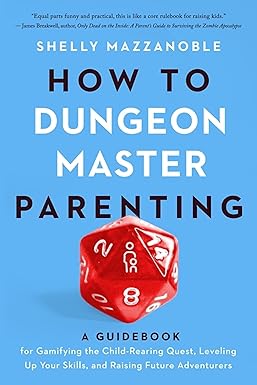
I’ve written a ton about video gaming and how my husband is a huge gamer. This includes ongoing Dungeons & Dragons campaigns, roleplaying games, Magic the Gathering, and anything else that uses a D20. So I was super psyched to get How to Dungeon Master Parenting by Shelly Mazzanoble. Yet another super late review for NetGalley, but I wanted to save this one for October.
How to Dungeon Master Parenting: A Guidebook for Gamifying the Child Rearing Quest, Leveling Up Your Skills, and Raising Future Adventurers by Shelly Mazzanoble
The blurb: For years, millions of fans have looked to the beloved roleplaying game Dungeons & Dragons for fun, friendship, and entertainment. And now parents and parents-to-be can use D&D to gain inspiration and how-to when it comes to their most challenging and rewarding role yet. Dungeon Masters are not just expert storytellers and arbiters of the rules, they’re compassionate, creative, quick-thinking leaders who embody the same traits that make a great parent.
I will start with my one obstacle with this book: it’s written like how you would speak if you were trying to be a stand-up comic. Yes, if the book is about D&D, you’re gonna want to prove you’ve played the game and you’re going to add a lot of fantasy, detail, and inside humor. It’s a bit overdone for this book, meaning it could’ve probably been under 150 pages.
Secondly, if you’ve already read a lot of parenting books, the how-to sections are unnecessary. I obviously have gotten through pregnancy and the infant stage, so I found those whole passages to be skippable/skimmable. If you are a first-time parent and you need a little nerd humor to get through your primer, go for it.
In the parenting landscape, your parenting style is emblematic. So to say you’re a Dungeon Master parent is kind of a cool analogy. It gives me fun, nerdy, bookish parents vibes. I agree with Mazzanoble’s premise that the traits of good Dungeon Masters align well with parenting:
Doesn’t try too hard
Recognizes simplicity is best
Caters to all parties
Skilled at improv
Good listener
Aware of limitations
Does what’s right for the party
Willing to give agency
Sense of humor
When my kids play Hero Kids, a younger D&D tabletop game, I can see how my husband manages their party, guides them through a story with excitement, and lets the dice decide. He keeps everyone focused, collaborative, and invested in the journey. It’s a skill that I appreciate in my parenting partner.
So here are the takeaways that resonated with me:
They’re more like guidelines, anyway
“No one learns how to play basketball by reading the rulebook. You learn by watching and doing.”
A Dungeons & Dragons campaign/story is not written in stone. There are pre-set campaigns, but mostly the Dungeon Master is the narrator. They already know the full arc of the story, the rules, the map, the NPCs, and they guide the players on their quest. No matter how painstakingly they’ve crafted the story plan, it’s ultimately up to the players to play it. Just like parenting…
We all have ideas on how we want to parent, what we think is best for our kids, but it’s not our life. There are no hard and fast rules to parenting, no matter how much you try to course correct.
Session Zero
Session Zero is when everyone in the party introduces their character. You could be a healer, a sage, a warrior. If you aren’t sticking to the usual D&D fantasy world, the possibilities are endless. Troy has been a smooth-talking pickpocket, an androgynous hacker, and a steampunk pirate smuggler. The Dungeon Master incorporates each characters’ backstories, strengths, and traits throughout the campaign.
Session Zero reminds me of the time pre-pregnancy when you and your partner are talking about all the things you want to do with your future kid. You talk about how you grew up, what parenting style you want to try, what it would be like to have a future dancer or hockey player, etc.
Eventually, your kid is born and grows to like something completely different. Keep tabs as your kid’s personality develops and levels up. This includes their weaknesses, special proficiencies, their difficulty class, chosen weapons, training, and constitution. Make sure that you don’t lose the plot, and that you are guiding the story for the kid you have.
Character Cards
In D&D, kids are playing a character, but also themselves. If they pick a certain archetype, it’s probably because they see themselves in that character. I dated a guy who played as a Mage, and he actually was a magician in real life…. A roleplaying game is great insight into your kid’s imagination, personality, and what they would do in hypothetical situations, fantastical or not.
In each round, each player can draw a card, roll to move, knock on a door. Like in the first episode of Stranger Things, Will had to decide if he was going to attack a Hydra and potentially sacrifice himself, or take a smaller hit and turn back. Do you protect the group or protect yourself? Do you instigate drama or do you keep to the rules? Do you play to make a great story, or do you win by controlling others?
So pay attention to the types of players your kid gravitates toward, as well as how they approach and play the game.
Semi-related side note: Fiction teaches empathy, especially for boys. After a certain age, boys have seemingly stopped reading for fun. This includes fantasy/sci-fi, even comic books and graphic novels. Reading fiction gives the reader another mindset and history to pull from. It creates new situations and forces the reader to emotionally relate and assess, free from judgement. A roleplaying campaign is essentially interactive storytelling, a choose-your-own-adventure that incorporates chance, patience, and the potential for failure. We talk on the blog about allowing opportunities and teachable moments for building empathy and grit. D&D is a good outlet for that, as well as teaching inclusion, problem-solving, and listening.
It takes a party
D&D is a collaborative game. There is not a single winner; you play as a team. So you must be a good listener. You must communicate your ideas together. You work with each other’s strengths and weaknesses to defeat the challenge/monster/curse ahead.
Yes, this game teaches kids teamwork, strategy, and diplomacy. But, this also works with parenting. You have to work as a team with your spouse/partner. Your hunting party also includes your kids and their input.
What makes a good DM
In addition to the previous list of all the Dungeon Master’s sunny traits, Mazzanoble continues the analogy into discipline, family dynamics, building and managing personality, and how you can add Dungeon Master tools to your own parenting inventory.
What I appreciate most however is that being a Dungeon Master isn’t just a role, it’s a mindset. This also parallels my Project Management studying. If a challenge or a question comes up, you can’t just do what you would intuitively or personally do. You have to see the challenge through a DM/parenting lens. If your kids want to go off script, you don’t go for the immediate shut down. You roll with it, you investigate, you see if it leads somewhere more enjoyable, you follow a procedure to make sure it works for the team and for the overall story. I think this helps parents get out of the rigidity that our schedules and worries can put us in. And in the end, enjoyment is measured by the happiness of the party and not the glory of being Best Parent Ever.
Also keep in mind that you are leveling up, too. As your kids get older, they gain skills and experience, and start to take on more challenging quests. But your skills as a parent grow just as well. The things you thought were difficult and infuriating before, now don’t seem that tricky.
Throw for it
The concept of using dice to determine an outcome stuck with me. I’m the type of person who hates always saying no to a request, so I try to balance it with a compromise or at least going one yes for every 3-4 nos. Troy had the idea of rolling for it as a way to leave it up to chance and not play bad cop all the time.
So if your kids can’t decide on what to do for Friday family night? Roll 1-5 for a movie, 6-10 for a puzzle, 11-15 to go out, etc.
If there is a dispute over who gets the tablet first, roll for it. If there is a failed negotiation over screen time, whatever number you roll is how many minutes you get. The choice is literally in their hands, and I don’t have the Mean Mommy face on.
I thought this was a fun, quick read and again, it’s not a start-from-scratch parenting style. It’s a perspective to help you get a little more enjoyment out of being a parent, especially if you fall on the nerdy side. And with all the adults reading faerie fantasy, that is a much bigger pool nowadays.
If you want to get your kids (or yourself) into D&D, the author has a chapter about starting a club in her kid’s school. I’ve mentioned Hero Kids, but Munchkin and all of its expansions are good starters, too. DnD Adventure Club is a beginner subscription service for kids campaigns.
Happy Halloween!

Browse here for more Child(ish) Reads.
Like this post? Follow Child(ish) Advice on Facebook, Pinterest, Instagram, and TikTok.
 Child(ish) Advice