
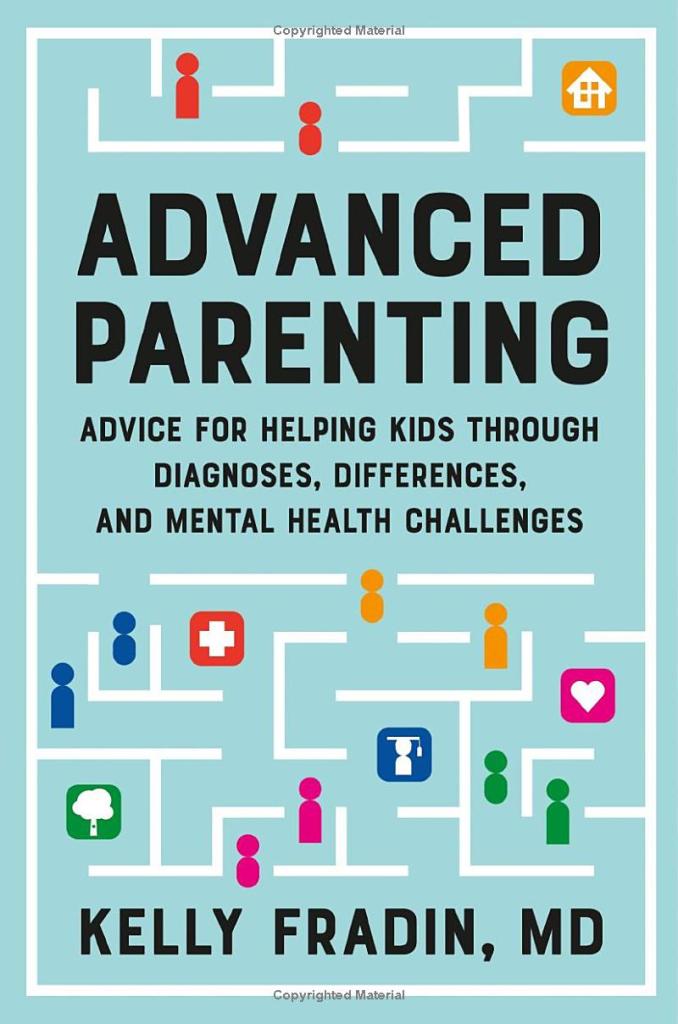
Advanced Parenting is one of those books that I thought wouldn’t really apply to me, but I knew it would give me a new perspective. I do not yet have a child with a specific medical diagnosis. Neither of my girls have allergies so far, they are neurotypical as of now, and I don’t believe they anything hereditary that we need to be on the serious lookout for. However, so far is not never. I don’t think parents really prepare for medical challenges until they happen, and then it all comes at you so fast.
While the subtitle of this book really hits for special needs parents or parents whose kids have been diagnosed with cancer or other diseases/disorders, the book also covers other challenges that common for kids: ADHD, asthma, diabetes, food allergies, gastro/feeding issues, learning disabilities, eczema, anxiety and depression, and developmental delays. I can also see the book applying to NICU parents.
The author, Dr. Kelly Fradin, is a complex care pediatrician and mother. She sees patients that often have chronic illnesses and long-term health care plans with specialists, surgeons, and therapists. Fradin also had childhood cancer, so she has a very clear, empathetic perspective for this writing this book. She also includes many case studies from previous patients, illustrating complex care and what kids and families deal with on that journey.
At the end of the book, Fradin relates that even families that do not have these types of health challenges can still benefit from the book because it can strengthen a parent’s confidence and clarity when advocating for their child.
Growing up, my stepmother at the time was a Special Ed teaching aid and CNA. So, we were around complex care families and students, and I’m familiar with that infrastructure. However, I would rarely see this type of specialized care among my peers. Perhaps one or two kids would carry an inhaler or I would have a friend who was in an LD class versus a general subject class.
In a short two generations, we are now hypervigilant about seeing red flags, early intervention, IEPs, and specialist care.
*One in 5 kids have a mental health diagnosis and only half get care.
Here are my top takeaways:
Common Parenting Reactions
Right off the bat, Fradin says that parents whose kids have just received a diagnosis usually fall into two categories. First is the overzealous parent; the one getting second, third and fourth opinions, noting every red flag, and spending hours down an internet rabbit hole. This parent can micromanage, be a Karen, and will most likely buckle under the added stress.
Second is the parent in denial. This parent shrugs off red flags, says “you’ll be fine” too much, and often drags their feet when it comes to following up.
Both are ends of spectrum and both use either their inaction or overreaction to cope with the fallacy that the diagnosis is a reflection of bad parenting. Reminder: Medical diagnoses, especially the ones covered in this book, are not in your control. You are NOT a bad parent.
Ideally, it’s best for parents to land right in the middle of the spectrum. Doctors want parents to be active supports in their kid’s health care plan. Overzealous parents can complicate care plans and bring added stress to both the doctors and their own kids. You have to use your own intuition but also balance your emotions.
Quarterback Your Child’s Care
Depending on the diagnosis, there can be lots of characters in play. This book recommends the team aspect: teachers, pediatrician, parents, therapists. These are all people who are in your child’s life, who all need to be in communication with their care plan. School nurses and counselors also need to be in the loop, and extended family can also be secondary caregivers.
Again, while this is more prominent for kids with long-term conditions and disabilities, it also applies to kids with behavioral diagnoses, food allergies, mental health issues, and sensory issues. These are all conditions that could obstruct your child’s learning environment, home environment, etc. So when you are working with your doctor to put together your child’s care plan, also keep in mind school, district, and state services. These are all outlets who can assist in putting together 504 plans or IEPs, assisted in-home or in-classroom care, or therapy/counseling.
Fradin also includes the importance of parent communities. Parents whose kids have the same diagnosis are great resources when it comes to getting referrals, sharing parent hacks, and asking questions. These can be in-person group meetings, social media groups, or church groups and so on.
Don’t forget that you (the parents) are also a vital part of this treatment team. No one knows your child better than you do and your insight is valuable. From their past history, daily routine, prescription side effects and observations, to actually being the one getting them to and from medical appointments, and giving them security and comfort. In this situation, the parents need to clearly communicate and relay information to the entire involved network.
Navigating Medical Obstacles
As with most complex situations, there are always challenges. Obviously, health insurance and finances are big factors. The time parents can or cannot afford to commit is another. The book brings up poverty, literacy, and age as other barriers to care. School services might also be limited depending on staffing or other kids needing those same resources.
In addition, you have paperwork, delays in service, commuting, time away from your job, time away from your other kids, and redundancies. All of which are very frustrating, making you feel like no one cares about your kid and time is of the essence. In some cases, you are calling out of work, cancelling commitments, losing sleep, recruiting additional help from family, and there’s a lot of hurry up and wait.
As hard as it can be to swallow, parents need to reframe expectations when it comes to speed of care and evaluation. It’s a bit of a cold reality, but you have to tell yourself to be flexible and that people are doing the best they can. You should also extend this grace to yourself.
It is also ok to have questions about second opinions, alternative care, or adjusting prescriptions. This doesn’t mean that you don’t trust your care team or modern medicine. Sometimes these options can help you feel a little better about your plan or make it an easier journey for your family.
The Internet
“Research can be a rabbit hole. It can also be a sign of anxiety. But a knowledgeable parent can ask the right questions.”
While I think Millennials are fairly adept at figuring out the fake news, it’s different when you are actually in a doctor’s office or a teacher conference getting distressing updates about your child. Digital literacy is paramount to weeding out fear-based tactics online. With all of the potential barriers and delays in care, it can be very easy for a parent to scour the internet looking for “the cure”, which may or may not exist. So, take a break every now and then from all the journal articles and Reddit threads.
The Home Front
This section is two-fold. First, we cover the kids.
Fradin introduces the book with her story of having childhood cancer. While her mother is telling her about radiation and chemotherapy treatment, she asks back, “Yeah, but do I still get to play?”
When kids become patients, sometimes we forget about their other needs: play, social interaction, routine, and normalcy. This also applies to older kids. While they may not have control over their condition, they should still have a say in their treatment and their time.
Fradin offers that giving simple choices helps give your child more control and options. This can be empowering and it also reassures that they are being heard.
She also advocates for giving kids space to make mistakes with their health, especially during puberty. This can help kids identify problems and troubleshoot on their own, allowing growth and emotional maturity. Set limits that are reasonable and empathetic.
Another point is that you most likely have other kids at home; kids that are healthy or neurotypical that still need a parent around. You may also have kids with their own conditions or medical needs that aren’t as urgent or may be more common. A sibling with a diagnosis or condition affects the entire family and everyone’s daily routine. It is very possible that siblings can get burnout, just as easily as the child needing medical attention.
If you have kids that are older, that doesn’t necessarily mean they are independent. Older kids, especially teenagers, have their own set of health needs.
The second part of this section is between spouses/partners. Caregiving for a child with complex care is not easy and it’s rarely an equal division of labor.
Complex care usually requires one or both parents to take considerable time away from work. This isn’t always financially possible, and can cause a lot of tension in the workplace and in the home. Another instance that can be problematic is if only one parent is looped into the care plan (managing appointments, giving prescriptions, setting up equipment) and the other parent doesn’t know the system. One parent could be bearing the full responsibility of the care plan and not feel supported by the other.
“Division of labor is not always equitable, however if both coparents are okay with this situation, then that is a reality as long as it is SEEN.”
For this situation, both parents need to be in communication and talk about how they can both support. Fradin points out that parents are in different stages of grief all the time, from denial of negative outcomes or time passing, to anger with doctors or their partner, to full on depression, burnout, overwhelm, and loneliness.
Often when a child is given a diagnosis, Fradin says that there are actually two patients to care for: the child and the parent. Stress management plays a very big role throughout the entire journey. Even after treatment and follow-up are done and your kid can resume a somewhat normal life, parents still might be traumatized by the whole medical process.
It’s difficult to stay positive for your child if you feel like so many other things are happening to you emotionally and falling by the wayside, even just temporarily. Parents need to keep up with their own mental health care; whether that be through talk therapy, alone time, a personal hobby, or getting help every now and then to delegate responsibilities.
To conclude, Fradin tells us about acceptance. This is the positive pivot and what brings it back OT and this blog. “We can’t always fix the root cause, but we can modify the environment and our own expectations to improve the outcome.”
I liked that this book is no-nonsense when it comes to the real responsibility and stress of parenting and caregiving. The patient stories are really heartfelt and they show how kids and parents can adapt to their medical situations at every point in the journey: diagnosis, treatment, observation, post-care.
Thursday, Mary is writing about parent advocacy and I think these posts marry together very nicely. Even if your child is just having a hard time at school or they need help with managing their emotions, we never know what kind of challenges our kid is going to present us with. But no matter what, you are always going to be your child’s best advocate.

Related podcasts:
Parenting Through Challenges with Dr. Kelly Fradin, ParentData by Emily Oster – April 5, 2023.
Ep. 222: Managing the Overwhelm in Neurodiverse Families, Beautifully Complex – May 17, 2023.
Kelly Fradin, Advanced Parenting, Moms Don’t Have Time to Read Books – April 12, 2023.
Advanced Parenting with Dr. Kelly Fradin, Best of Both Worlds – March 28, 2023.
Browse here for more Child(ish) Reads.
 Child(ish) Advice