The first time we wrote this post, we decided it was not going to be a how-to on potty training. Instead, we wanted to share our different approaches and normalize the experience for parents. While going to the bathroom is obviously easy for adults, having the patience to coach your child through potty training is a whole different story, wrought with frustration and a lot of Clorox.
So now, two years later, we are on to Round Two.
sensory processing
Course Notes: The Cerebellum

We have talked an awful lot about the prefrontal cortex and its significance to our performance in everyday life. But what about the back of the brain, like the cerebellum? Where’s the love for that neural region? Turns out that “little brain” found at the base of the skull right above the nape of neck deserves so much applause for what it does.
The cerebellum was the topic of my latest CEU course, so this post is going to get a little technical. But trust us, it’s worth the read.
For centuries, it’s been believed that the cerebellum was only responsible for unconscious motor movement, like balance and reflexes. Although that is true, it’s not its only job. Researchers are finding out more and more about how important and involved the cerebellum really is to our day-to-day operations and what happens when it goes awry.
With its Latin name meaning “little brain”, the cerebellum makes up 10% of the brain’s volume. However, it carries about more than 50% of all the neurons (nerve cells) in our entire body. With the more neural connections than any other part of the brain, the name doesn’t seem as fitting as it once did.
Continue readingTreat Yourself: Sensory Valentine
On Pinterest, there are hundreds of links on how to make a sensory bin or do sensory activities for your kids. We know through all of our OT-forward wisdom that it is important to integrate sensory components in your child’s development. But what about us?
Our adult sensory system allows us to regulate our arousal levels to appropriately engage and complete our daily routine. When we ignore what our body is seeking in order to make it through the day, we can become agitated or distracted and those nearest and dearest become unfortunate casualties (sorry spouse).
We’re starting to hate the phrase “self-care” because it’s turned into all this noise about buying stuff and going to spas. This is called “prescribed balance”; it’s all of these things that society says we should do because it’s supposed to help us fix ourselves. In reality, it’s just another to-do list unless you are actually listening to what your body needs.
Those little things—from the smell of pancakes and bacon in the morning, to feeling the cool breeze during an evening stroll, to snuggling up under the covers while reading a good book—all have a sensory component and can be the unsung heroes of our own recovery. Here are some sensory suggestions to help you reset your happy.
Continue readingThe Things We Do For Our Kids

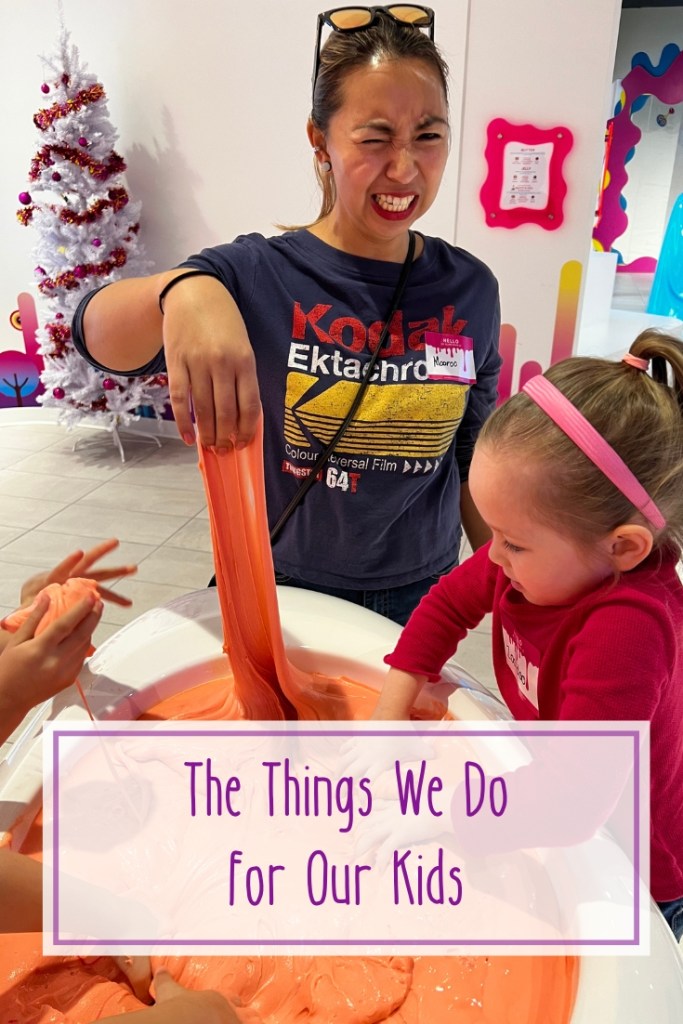
I’m openly tactile defensive. Even though my tolerance of certain things on my hands have improved, I don’t actively seek to get my hands dirty regularly. That is, until my bestie and fellow blog writer suggests we go to the SlooMoo Institute for a playdate (enter cringe mode).
Here’s the thing: Even though going to an immersive slime exhibit isn’t something I’d want to do, I knew my 5-year-old would enjoy it. Why miss a new experience for him because I can’t handle a little slime on my hands…or clothes. Agh, I digress.
This post isn’t about me or my dislikes, but rather how many parents do things we avoid, fear, or loathe for the sake of our kids. It’s very common that some parents don’t want their kids to inherit their own phobias, and they especially don’t want their kids to miss out. Whatever the reason, we know that we play a large role in our children’s learning and growing experiences.
Continue readingWilly Wonka Series: Augustus Gloop
Augustus Gloop is the first kid to find a Willy Wonka Golden Ticket. His mother, Mrs. Gloop, explains to the reporters that it’s no surprise that her son found the ticket since he eats chocolate bars all the time. Unfortunately, his time on the tour is short-lived as he accidentally falls into the chocolate river and sucked into a pipe to the Fudge Room.
Kids need fuel to keep up with their activity level and to help them grow. But despite consuming three daily meals and snacks, there may be other motives as to why some kids continuously seek food.
Continue reading