Our Activate Playdate Review

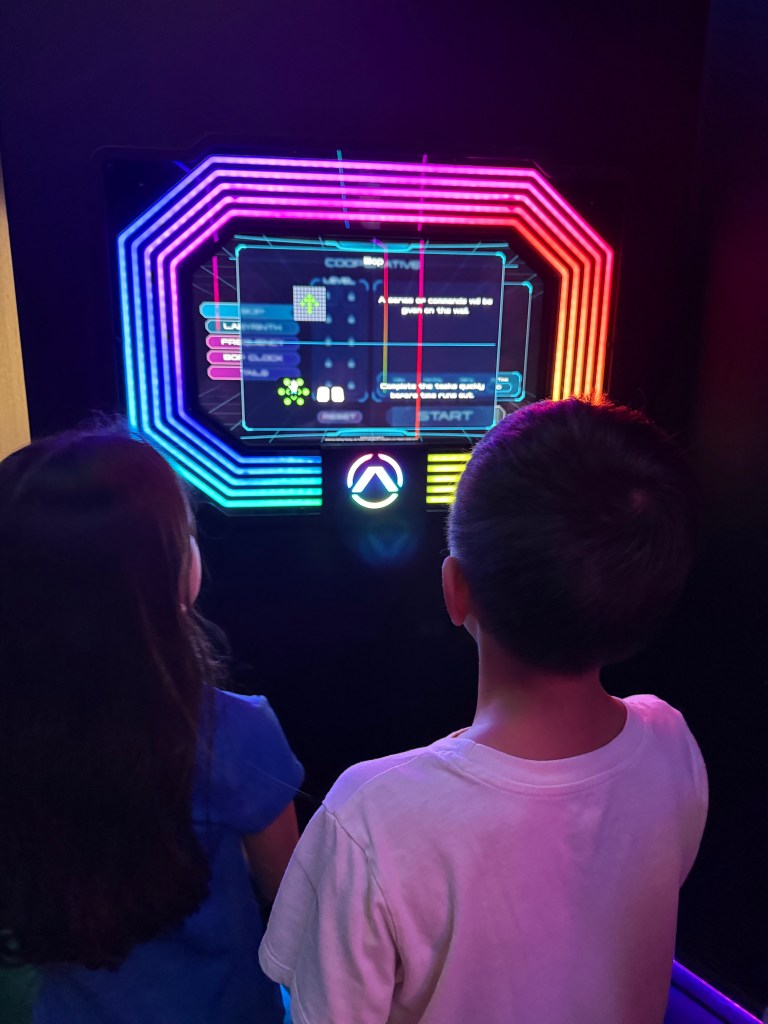
For our last 2025 Playdate Review, Mary and I headed over to Activate Games. We had brainstormed this venue a few years ago, but our kids were just under the age recommendation. Now that they are 7 and 8, we decided to give it a try and see how theyโ€™d fare.

Activate is an indoor, high-tech gaming facility where you and your friends physically step into interactive game rooms that blend technology, puzzles, and movement. Itโ€™s like stepping inside Nick Arcade. The environment reacts to your movements in real time. Each themed game room is filled with lights, sensors, and challenges:

  • Laser mazes: Duck, dive, and dodge beams to reach the other side.
  • Arcade-style basketball hoops: Fast-paced scoring challenges.
  • Puzzle rooms: Memory, logic, and teamwork tasks.
  • Climbing and agility rooms: Test your speed and coordination.

The kids have all done their fair share of video gaming and interactive gaming with their consoles, VR, laser tag, and Immersive Gamebox. Mary and I have also had a couple adult group outings with immersive gaming. Could we shepherd them into a new gaming world??

Continue reading


The Girl Brain

While working at a pediatric clinic, seasoned therapists often noted that boys responded best to clear expectations and consistent consequences, while girls benefited more from patience, emotional connection, and time to process instructions and feelings.

When I was just starting out, I assumed all kids processed things the same and saw girlsโ€™ need for patience as coddling. For context, I was raised in an Asian household where emotions were seen more as a weakness than an asset. So, if you had to cry, go outside.  

With time however, I realized I was wrong. It wasnโ€™t that they didnโ€™t understand the task; it was that they wanted to get it right so badly. Sometimes theyโ€™d miss the mark on the first try, or theyโ€™d misread my tone and think I was upset with them. Other times, they were simply grappling with the fact that there was no room to negotiate the task or the consequence. What they needed wasnโ€™t leniencyโ€”it was time, clarity, and emotional safety. Check out this IG video.

We know that boy and girl brains are different, but what are the actual characteristics a girl brain and makes itโ€™s learning processes distinct from its male counterpart?  

Continue reading

The Boy Brain

Ever since my son was in daycare, Iโ€™ve heard โ€œboys will be boysโ€ tossed around. This was mostly to explain his energetic, impulsive behavior, especially during play or social interactions. Iโ€™ve never liked that saying. It felt like a shrug, an excuse, as if rough-and-tumble behavior is inevitable or exclusively male. And letโ€™s be honest, girls can stir up just as much chaos as their male peers.

But as he moved into elementary school, the patterns became harder to ignore. More boys in his grade were on medication for ADHD. More boys were getting flagged for disruptive behavior. The gap wasnโ€™t just anecdotal anymore. It was showing up in classroom dynamics, discipline charts, and parent-teacher conferences.

Recent research confirms that there are differences between male and female brains, but I keep wondering: Are those differences present before puberty? And if they are, how much do they actually shape the way boys and girls learn, connect, and navigate the world around them?

In this two-part series, weโ€™ll explore how brain development may diverge between boys and girls, and how we can best support them as parents as they grow. First up: The boy brain.

Continue reading

Breaking Down So Badly: After-School Restraint Collapse

The first few weeks of school can be a bit of a Jekyll and Hyde situation. Your kidโ€™s teacher tells you theyโ€™re doing great at school, making friends, paying attention, all that good stuff. But thatโ€™s not what you see when you get home. In fact, you get quite the opposite (screaming, crying, perfect storms). So, what in the T. Swift is going on?

Turns out that these fits and meltdowns are typical, so typical that it even gets its own special name: After-school restraint collapse. Originally coined by counselor and parenting expert Andrea Loewen Nair, it refers to a childโ€™s emotional, mental, and physical release once their school day is over. School is regimented with rules to follow and lessons to learn, plus picking up all the social cues and expectations from classmates and teachers; all requiring mental stamina and self-control. So once our kids hop in the car or get off the bus, they start to decompress in whatever form they see fit.

Continue reading

Making Sense About Speech: Sensory Integration and Speech

Speech and language are not easy skills to achieve. Before we can talk or make sense of what people are saying, our sensory foundations must be established. This explains why most kids arenโ€™t fully conversational until around 3 years old.

For example, intelligible speech canโ€™t happen without the cooperation of the vestibular (movement), proprioceptive (body awareness), and tactile (touch) systems who govern the fine motor movements, coordination, and motor planning of the throat, lips, and jaw. If we are to understand a conversation, our auditory (hearing) system needs to differentiate between sounds of words to not mix up what someone is communicating to us.

This all ties back to sensory integration.

Continue reading