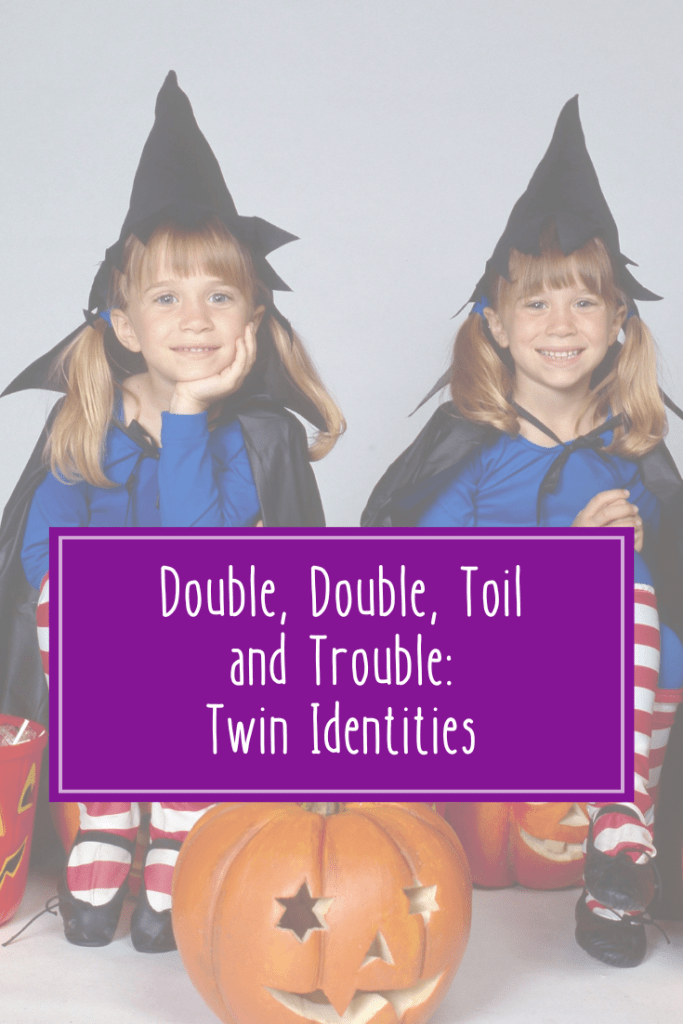
Double, Double, Toil and Trouble: Twin Identities

Aunt Agatha: I have Lynn!
Kelly Farmer: I’m Kelly!
Aunt Agatha: Oh, whoever. I have your sister! If you care about her, you’ll give yourself up now!

Twins are often seen as a packaged deal, especially if they are identical. You can’t say Mary-Kate without thinking about Ashley Olsen, or Tia and Tamara Mowry. Even my own twins are known at school simply as “the twins” or “H and K.”

Mix-ups and mistaken identities are common; and while they may seem harmless, these moments subtly shape how twins see themselves and relate to others. That’s why it’s so important for parents to recognize each twin as a unique individual, with their own personality, behavior, and strengths. This isn’t always easy as physical resemblance, emotional closeness, and family dynamic can make individuality harder to nurture. Factor in the reality that they’ve had a constant companion since the womb, and the journey toward individuality becomes even more layered.

Continue reading

Child(ish) Reads: A+ Parenting

Of course for Back-to-School month we’re reviewing a school(ish) book. This one thankfully is a much more productive read than last year’s. I received an advance copy of A+ Parenting via NetGalley. Technically the book came out in October 2023, so I hope NetGalley will forgive my tragically late feedback.

A+ Parenting: The Surprisingly Fun Guide to Raising Surprisingly Smart Kids by Eva Moskowitz, with Eric Grannis.

Summary: Eva Moskowitz has built a national reputation as the founder and leader of Success Academy Charter Schools, one of the country’s most highly regarded networks of schools. But while most people know Eva for her success in educating 20,000 mainly low-income students who are routinely accepted to our nation’s best universities, she has also been responsible for raising three children of her own. In A+ Parenting, Eva shares what she has learned both as a parent and an educator about raising children to be enthusiastic and successful learners.

Continue reading

Course Notes: Social and Emotional Development, pt.2

Social and emotional development involves gaining the capacity to understand, manage, and express. One way to guide its growth is with social and emotional learning (SEL). While this systematic approach is often seen in educational settings, it can be applied across the lifespan.

There are five competencies in this area, also known as the CASEL 5. They are:

  • Self-awareness – recognize one’s own emotions/thoughts/interests/values, how these qualities influence actions, as well as maintaining a positive self-view and belief in abilties
  • Self-management – regulate emotions/thoughts/behaviors in different situations, handle stress and resist urges, and set goals
  • Social awareness understand subtle social/cultural rules and norms, considers other perspectives, show respect and empathy towards others
  • Relationship skills – establish and maintain relationships with others, resist negative social pressure, work well with others, prevent and solve conflicts with others, seek help when needed
  • Responsible decision making – accurately identify and evaluate problems, make decisions based on ethical and social norms, consider context when making decisions, contribute positively to the community

These skills enable us to maintain a healthy self-perception, manage stress effectively, comprehend others, and collaborate to support the community.

Continue reading

Course Notes: Social and Emotional Development, Pt. 1

Being an OT-forward blog, we’ve written a lot about motor and cognitive development, but what about the social and emotional?

My most recent course focused on just that: Social and Emotional Development – Therapeutic Interventions for Children, Birth Through Adolescence. From that seminar, we think it would be helpful for many parents to understand how social and emotional development builds as our kids get older, similar to all those Development Milestones we watch so closely.

Social and emotional development refers to a child’s ability to understand who they are, what they are feeling, and how to navigate social interactions. These skills are essential for forming and maintaining positive relationships, expressing and managing emotions, and effectively exploring and engaging with their surroundings and other people.

Continue reading

Low Tech Culture

“Learning about yourself and what you’re drawn to is one of the cool things about growing up.” – Rachel Childers, musician with the Boston Symphony Orchestra

To piggyback off our last post, we’re sharing the low-tech devices your kids can use to find their musical tastes.

Hey, there’s nothing wrong with going old school. If you still have these lying around, introduce your kid to the classics and low-tech tech.

Continue reading