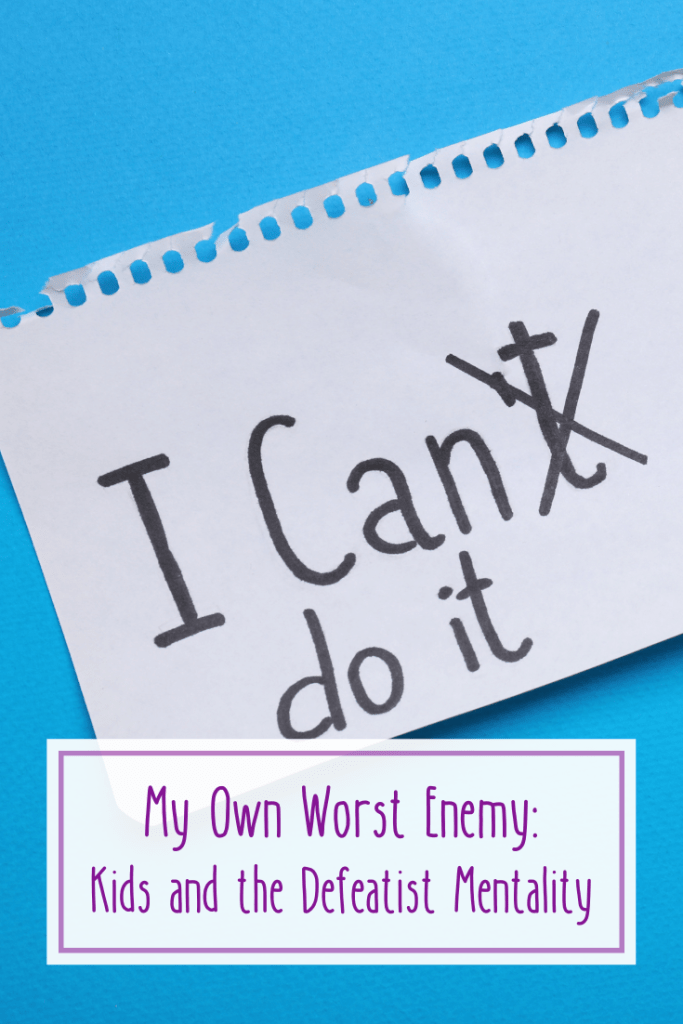
My Own Worst Enemy: Kids and The Defeatist Mentality

It can be really heart-breaking (and equally frustrating) when we hear our kids say, “I can’t do it. It’s hard. I quit.” Giving kids challenging tasks can make them take a step back and reassess the situation, but what do we do when these thoughts completely influence their mindset and outlook?

Lately, Patti’s 6-year-old Z has been going through these bouts with reading and writing. If she misspells a word or has trouble sounding out a word, she gets heated, stops trying altogether, and then has a meltdown, claiming that everyone is being mean to her. To add a little detail, her sister and friends are slightly ahead of her in these subjects and she feels like she is either left behind or we’re being too hard on her.

From birth, kids quickly learn new skills and gain the confidence to use them. As they get older, that confidence allows them to trust their own capabilities and bounce back if they’re unsuccessful at something. We know resilience builds after facing setbacks. So, it’s tough to see our kids throw in the towel without trying.

Continue reading

Oh, The Pain…The Pain!

Cuts, scrapes, and bruises are part of childhood. That curiosity and “f*ck around and find out” mentality helps build resilience long-term. While it’s expected for kids to whimper when they get a booboo at two, it’s a quandary when they continue to do it at eight. After one too many “Toughen up, Buttercups”, we started to wonder about pain tolerance in children. If they can’t handle a minor bug bite or dodgeball hit, then how do we expect them to handle a dun-dun-dun… flu shot?

But the truth is that pain is a highly complex and individualized experience, influenced by a multitude of factors. For today’s post, we’re deep diving into the concept of pain and how to better help our kids manage it. 

Continue reading

A Resilient State of Mind: Dealing with Failure

Part of a child’s job is to learn, and failure is an inevitable part of learning. Failure is also an inevitable part of building resilience. Resilience is the ability to face life’s stressors/challenges, learn from mistakes, and recover. It’s a big cause and effect game happening in your child’s brain.

Our kids fail all the time, especially when communicating what they want or need in the first years of life. As they get older and experiment with boundaries and connect information, they can organize all of that cause and effect and turn it into action. They figure out what works (asking for help) and what doesn’t (throwing a fit), learning and adapting with each new situation.

But somewhere in their early school years, our kids can start viewing failure as a bad thing, limiting their exposure to new experiences, encounters, and achievements. What caused this switch and how can we help our kids embrace failure rather than avoid it?

Continue reading