Tippy Toes: The Deal with Toe-Walking

Toe-walking is exactly how it sounds, when a child primarily walks on the balls of their feet or on their toes, instead of using their whole foot. This is typical when a child is learning to walk independently. Children usually outgrow it before 3, as they develop a consistent stride and heel strike. 

However, some children continue to toe-walk for no immediate reason at all. This is known as idiopathic toe-walking. This means that, though a child frequently walks and balances on their toes, they can still physically keep up with their peers, walk with straight knees, and can stand with their feet flat on the ground. Idiopathic toe-walking has been estimated to occur in 7% to 24% of the childhood population.

Continue reading

The Less-Stress Mess

Following up on this week’s Tactile Response post, here is a fun activity to try. This can be done with children of all ages and helpful for those who may have an over-responsive tactile system.  This activity gradually introduces various substances or textures. 

Materials:

  • Ziploc bags
  • A base substance, such as finger paint, shaving cream, or lotion
  • Optional:
    Other small objects to add texture like rice, beans, buttons, or beads
    Food Coloring
    Large Spoon
    Cookie Tray
Continue reading

Can’t Touch This…

Full disclosure: I hate hate HATE the feel of certain textures.

I hate them so much so that I will find ways to avoid touching them. I will never play in mud. I refuse to clean out a pumpkin. The thought of kneading dough or mixing raw meat with my hands freaks me out. I will use a fork and knife to eat BBQ ribs or chicken wings because the feel of the sauces of my fingers genuinely stresses me out. 

As odd as this is, I’m not the only one. We may know kids that can’t stand the tags on shirts, the feel of sand on their hands, or when paint or glue get on their skin. Why? It’s an overresponsive tactile system. 

Continue reading

Anything Goes with Play-Doh®

Anything Goes with Play-Doh

We all know what Play-Doh® is…that yellow container filled with that non-sticky, clay-like dough, ready to be molded into whatever our little hearts desired. What we didn’t recognize was all the benefits we gained when playing with it. 

Aside from letting us create anything our imagination wanted, we were indirectly developing the strength and coordination in our arms, hands, and fingers necessary to complete fine motor tasks. Hmmm…wonder if that was Play-Doh®’s intention?

(Side note: It wasn’t. It was originally sold as a wallpaper cleaner in the 1930s.)

Continue reading

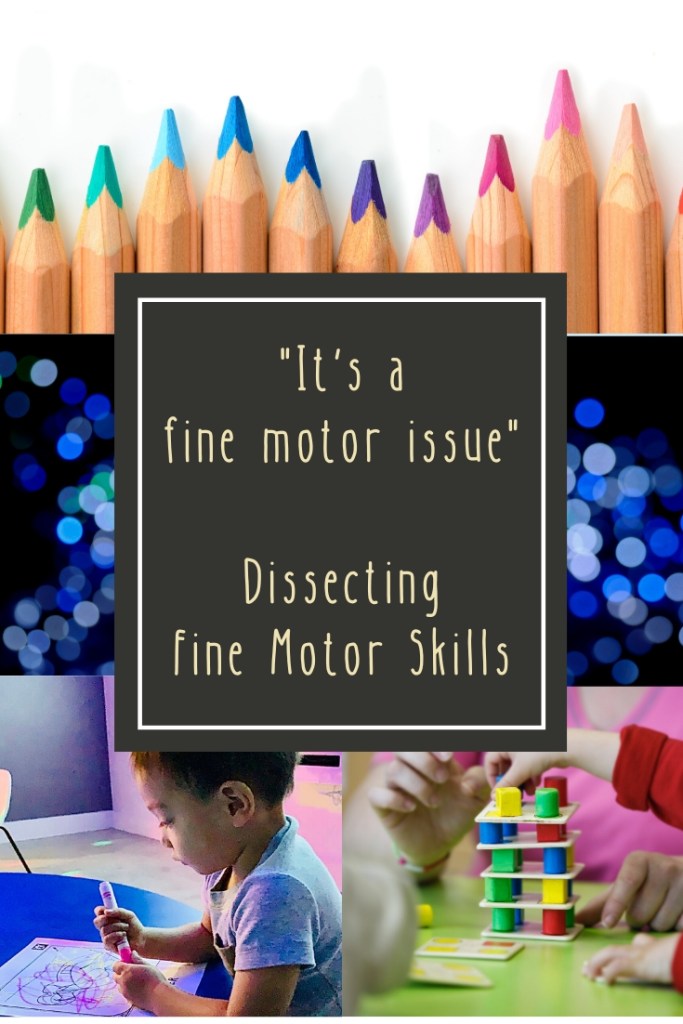
“It’s a Fine Motor Issue…”

Dissecting Fine Motor Skills

A common reason that children are referred to OT is for “fine motor issues.” However, it usually isn’t just a fine motor issue. There could be other factors involved.

What are fine motor skills? They are the coordinated movement that involves the use of fingers, hands, and arms. This includes:

  • Reaching
  • Grasping
  • Object manipulation (buttoning a button or putting coins in a piggy bank)
  • Tool usage (eating utensils and writing utensils)

These skills develop at birth and work with other areas of development, such as vision, touch, and postural and proximal strength/stability.  

Continue reading