child(ish) Q & A: Pacifiers

Pacifiers are great soothers for a newborn, but could pose problems when a child gets older. When is it no longer necessary and when does it become a problem? Here’s a guide to the ins and outs of pacifiers: 

What is a pacifier?

Called by many cute names (Binky, Paci, bah-bah), a pacifier is a tool designed to soothe infants when they are crying. They are useful for satisfying the sucking reflex necessary for newborn feeding, reducing the risk of SIDS (Sudden Infant Death Syndrome) when napping or sleeping, and they help children learn to self-soothe. 
For this post we are only talking about rubber/plastic/silicone pacifiers. We also aren’t covering teething for this post. If you have any questions, please leave us a note in the comments.

Continue reading

Defying Gravity: Tummy Time

As a new parent, you receive a lot of rules about how to take care of your new bundle of joy. But, one is a bit hard to implement once you get home: Tummy Time.

What is Tummy Time?

This cute, alliterative phrase refers to any time when your baby is on their belly while they are awake and active. This position allows them to lift and turn their head from side to side, and provides the foundational upper body and core strength/ stability needed for reaching and crawling. 

Continue reading

child(ish) Q & A: Screen Time

child(ish) Q&A: Screen Time

Since our post “The Importance of Play“, we have received a few questions regarding the use of screen time. Here is a quick cheat sheet if you are in the middle of the screen time battle.

What is screen time?

Screen time refers to any sedentary activity involving the use of visual electronic media. Examples include: smart phones, tablets, computers, televisions, and video games.  Little to no physical effort is utilized during screen time. 

Continue reading

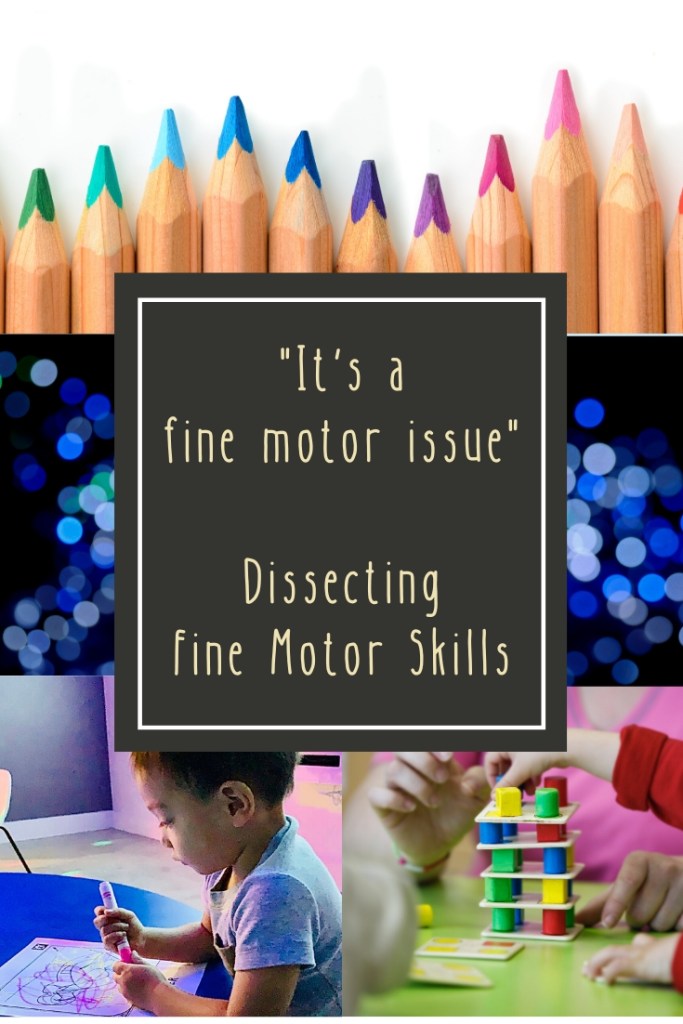
“It’s a Fine Motor Issue…”

Dissecting Fine Motor Skills

A common reason that children are referred to OT is for “fine motor issues.” However, it usually isn’t just a fine motor issue. There could be other factors involved.

What are fine motor skills? They are the coordinated movement that involves the use of fingers, hands, and arms. This includes:

  • Reaching
  • Grasping
  • Object manipulation (buttoning a button or putting coins in a piggy bank)
  • Tool usage (eating utensils and writing utensils)

These skills develop at birth and work with other areas of development, such as vision, touch, and postural and proximal strength/stability.  

Continue reading

The Importance of Play

The Importance of Play

If I asked you what children do, “play” would be one of the top 3 answers. 
But what is play exactly? It’s more than just a child engaging with toys or running around with other kids. It’s real work.

Play can be defined as “any spontaneous or organized activity that provides enjoyment, entertainment, amusement, or diversion.” It is an occupation that is intrinsically driven by curiosity and exploration to interact within their surroundings. It allows for imagination, the ability to pretend with limited consequences, as well as the opportunity to share and act out ideas other with no judgment. 


Notice that I said play was an occupation. 
Yes, PLAY is an important job that a child does from birth to 12 years of age. 

When a child plays:

  • They understand their own body and how it moves within space 
  • They learn about their environment, objects in relation to each other, and cause and effect
  • They engage their imagination
  • They learn how to build with various objects 
  • They interact with others and participate in games 
Continue reading