Can’t Touch This…

Full disclosure: I hate hate HATE the feel of certain textures.

I hate them so much so that I will find ways to avoid touching them. I will never play in mud. I refuse to clean out a pumpkin. The thought of kneading dough or mixing raw meat with my hands freaks me out. I will use a fork and knife to eat BBQ ribs or chicken wings because the feel of the sauces of my fingers genuinely stresses me out. 

As odd as this is, I’m not the only one. We may know kids that can’t stand the tags on shirts, the feel of sand on their hands, or when paint or glue get on their skin. Why? It’s an overresponsive tactile system. 

Continue reading
Anything Goes with Play-Doh®

Anything Goes with Play-Doh

We all know what Play-Doh® is…that yellow container filled with that non-sticky, clay-like dough, ready to be molded into whatever our little hearts desired. What we didn’t recognize was all the benefits we gained when playing with it. 

Aside from letting us create anything our imagination wanted, we were indirectly developing the strength and coordination in our arms, hands, and fingers necessary to complete fine motor tasks. Hmmm…wonder if that was Play-Doh®’s intention?

(Side note: It wasn’t. It was originally sold as a wallpaper cleaner in the 1930s.)

Continue reading

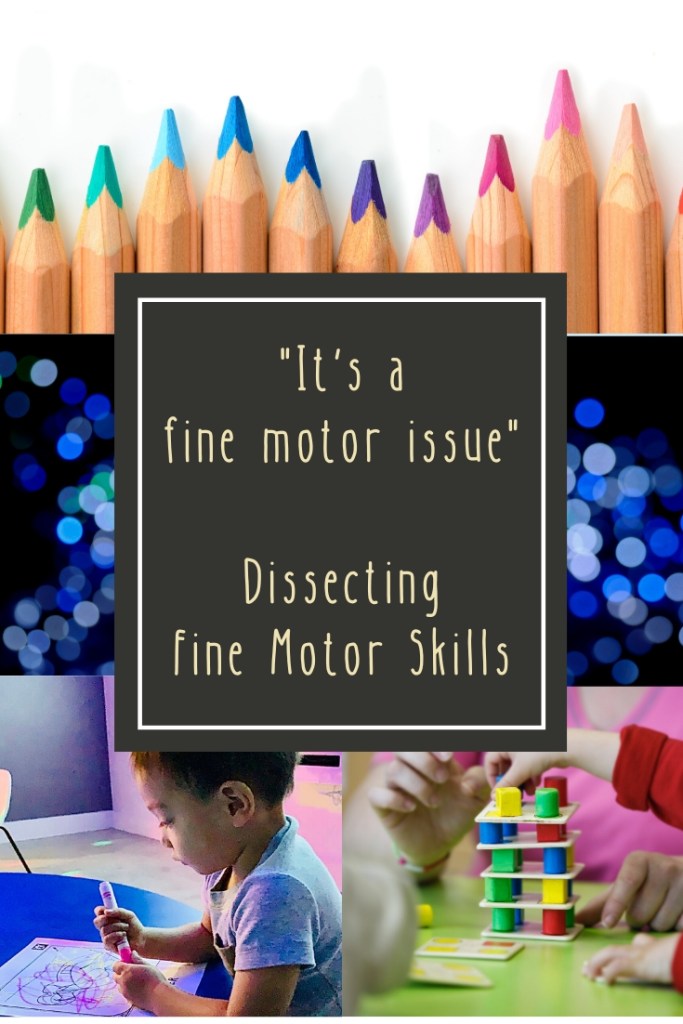
“It’s a Fine Motor Issue…”

Dissecting Fine Motor Skills

A common reason that children are referred to OT is for “fine motor issues.” However, it usually isn’t just a fine motor issue. There could be other factors involved.

What are fine motor skills? They are the coordinated movement that involves the use of fingers, hands, and arms. This includes:

  • Reaching
  • Grasping
  • Object manipulation (buttoning a button or putting coins in a piggy bank)
  • Tool usage (eating utensils and writing utensils)

These skills develop at birth and work with other areas of development, such as vision, touch, and postural and proximal strength/stability.  

Continue reading

OTs, PTs, and Speechies, oh my!

As an Occupational Therapist, my focus is to provide support to those who need assistance completing functional daily tasks and activities. This may be through building skills to complete tasks or adapting the environment to meet the child’s needs. This can also include working with Physical Therapists and Speech-Language Pathologists regarding concerns of movement and communication. 

Wait, what is the difference?

Occupational Therapy looks at the individual in terms of whether they can participate in meaningful activities or daily tasks that promote independence. Our specialty is analyzing an activity and determining the skills necessary to complete it. From there, we can either help the person build those skills or alter the environment so they can be successful in the activity. 

Continue reading

The Importance of Play

The Importance of Play

If I asked you what children do, “play” would be one of the top 3 answers. 
But what is play exactly? It’s more than just a child engaging with toys or running around with other kids. It’s real work.

Play can be defined as “any spontaneous or organized activity that provides enjoyment, entertainment, amusement, or diversion.” It is an occupation that is intrinsically driven by curiosity and exploration to interact within their surroundings. It allows for imagination, the ability to pretend with limited consequences, as well as the opportunity to share and act out ideas other with no judgment. 


Notice that I said play was an occupation. 
Yes, PLAY is an important job that a child does from birth to 12 years of age. 

When a child plays:

  • They understand their own body and how it moves within space 
  • They learn about their environment, objects in relation to each other, and cause and effect
  • They engage their imagination
  • They learn how to build with various objects 
  • They interact with others and participate in games 
Continue reading